Category: Palaeontological articles

Fossilised “Fish Lizard” from Iraq Changing the Way we View Ichthyosaur Evolution

Ichthyosaur Evolution Just Got a Lot More Complicated

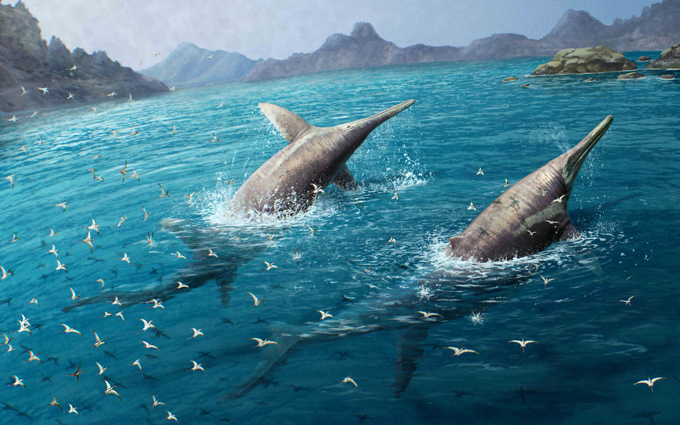
Ichthyosaurs were a group of marine reptiles that superficially resembled dolphins.  These streamlined, viviparous (giving birth to live young), predators seem to have evolved in the Early Triassic and became extinct towards the end of the Cretaceous.  Ichthyosaur fossils have been found all over the world, however, despite the wealth of fossil material (or perhaps because of it), there are a number of mysteries surrounding this Order that puzzle palaeontologists.  For instance, they do seem to be at least superficially, the best adapted to life in a marine environment when compared to the other types of marine reptile, the crocodile-like Metriorhynchids, the Mosasaurs, the long-necked Plesiosaurs and their shorter-necked relatives the Pliosaurs.  However, despite being very well suited to a nektonic lifestyle and there being a growing body of evidence to suggest that these types of “fish lizards”, were becoming better and better adapted to life in the open oceans as the Jurassic gave way to the Cretaceous, they still became extinct long before the Cretaceous mass extinction event that saw the demise of the other types of Late Cretaceous marine reptile.

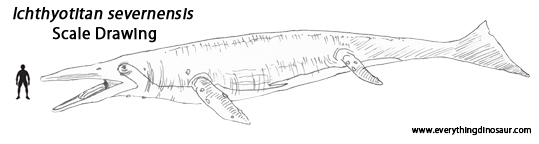
A Scale Drawing of a Typical Ichthyosaur

A typical "dolphin-like" Ichthyosaur.

A typical “dolphin-like” Ichthyosaur.

Picture Credit: Everything Dinosaur

The Order Ichthyosauria suffered a series of extinctions with three major extinction events identified over the duration of the Mesozoic.  As a result, those types of Ichthyosaur that survived into the Cretaceous from this Order’s Jurassic heyday were believed to a single branch of what had been a diverse clade.  The Cretaceous Ichthyosaurs were all relatively similar in their body plans and morphology and were believed to have shared a common Late Jurassic ancestor.  The lack of variation in Cretaceous Ichthyosaur body types, the general lack of diversity in the Ichthyosauria, was believed to have played a significant role in their ultimate demise during the Cenomanian faunal stage of the Cretaceous.

The publishing of a scientific paper (Biology Letters), outlining the research undertaken on a partial Ichthyosaur fossil specimen found in Iraq, may change the way in which the Cretaceous Ichthyosaurs are viewed.  This Ichthyosaur, named as Malawania anachronus (Mal-ah-won-nee-ah a-nack-kron-us), seems to contradict the long-held theories.  Malawania represents a “ghost lineage of Ichthyosaurs”, it resembles a more primitive form of this marine reptile Order, it does not appear to be closely phylogenetically related to other known Cretaceous Ichthyosaurs.

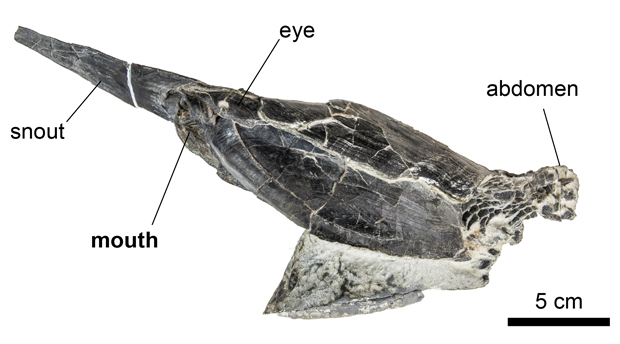
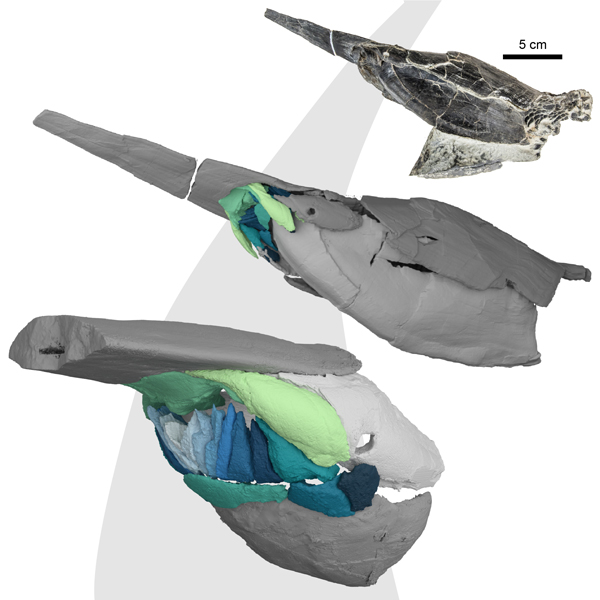
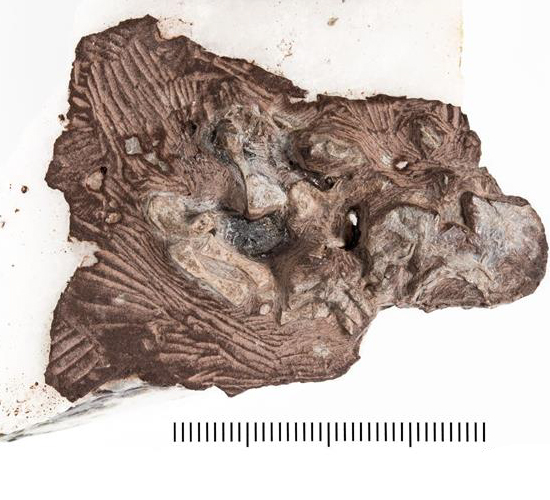
The fossil which consists of fragments of skull bones including a partial sclerotic ring (ring of bone around the orbit) and much of the front portion of the animal was discovered by British geologists exploring Kurdistan (north-eastern Iraq) in the 1950s.  At the time of its discovery, the slab of fossil material was not being treated with much reverence.  As one of the authors of the scientific paper outlining the study of this fossil, Dr. Darren Naish points out:

“Preserved within a large, flat slab of rock, it was being used as a stepping stone on a mule track.”

The Fossilised Remains of Malawania anachronus

The picture shows the fossil slab and a drawing illustrating the location of the fossil material.

The picture shows the fossil slab and a drawing illustrating the location of the fossil material.

Picture Credit: Biology Letters

Study of the specimen began during the 1970s with Ichthyosaur expert Robert Appleby, then of University College, Cardiff.  Although he recognised the significance of this fossil discovery, he unfortunately passed away before determining the precise age of the specimen.  However, the research into this strange Ichthyosaur, one of only two Ichthyosaur fossils known from the Middle East, was taken up recently by a team of international scientists and fittingly the contribution of Robert Appleby is acknowledged as he is credited on the list of authors for the scientific publication.

The research team conclude that this fossil contradicts the previous theories about the evolution and extinction patterns seen in the Ichthyosauria.  Lead author Dr. Valentin Fischer (University of Liege, Belgium) and his colleagues have named the specimen Malawania anachronus, the name means “out of time swimmer”, as despite being Cretaceous in age, the Ichthyosaur represents the last known member of a kind of Ichthyosaur which was believed to have become extinct during the Early Jurassic.  Analysis of the micro-fossils found on the slab of rock which contains the Ichthyosaur specimen, analysis of spores and pollen grains that have been preserved indicate that this Ichthyosaur lived approximately 125 million years ago (Barremian faunal stage of the Early Cretaceous).  The research team support this assertion by providing a cladistic study of the known Ichthyosaur fossil material to re-design the “Fish Lizards” family tree.  Here is evidence of a ancient, primitive Ichthyosaur assigned to the Thunnosauria group of Ichthyosaurs that seem to have originated in the Late Triassic.  This study suggests that in some parts of the world, primitive Ichthyosaurs survived relatively unchanged for more than sixty million years.

Commenting on the implications for this research, Dr. Fischer stated:

“Malawania’s discovery is similar to that of the Coelacanth in the 1930s: it represents an animal that seems ‘out of time’ for its age.  This ‘living fossil’ of its time demonstrates the existence of a lineage that we had never even imagined.  Maybe the existence of such Jurassic-style Ichthyosaurs in the Cretaceous has been missed because they always lived in the Middle-East, a region that has previously yielded only a single, very fragmentary Ichthyosaur fossil.”

The phylogenetic analysis undertaken by the research team suggests that several Ichthyosaur groups that appeared   during the Triassic and Jurassic geological periods may have survived into the Cretaceous.  This brings the extinction phases of the Ichthyosauria into doubt.  For example, according to this new study, the supposed end of the Jurassic extinction event may not have occurred.  The fossil record for the Ichthyosauria shows a very different pattern of extinction when compared to known, accepted data on other marine reptile groups.

The Evolution of the Ichthyosauria

A table compiled by the research team that explores the evolution and radiation of the Ichthyosauria.

A table compiled by the research team that explores the evolution and radiation of the Ichthyosauria.

Table Credit: Biology Letters

The position of Malawania anachronus is shown by the red line.  The chart at the top records the passage of time from the Middle Triassic to the Late Cretaceous and places known fossil material on this chronological scale.  The line graph below shows the proposed main periods of radiation of the Ichthyosauria and the herring bone diagrams at the bottom shows the proposed phylogenetic relationship between different genera.

When this research is taken together with the 2012 literature on the discovery of a new species of German Ichthyosaur known as Acamptonectes densus, another type of Ichthyosaur known as an Ophthalmosaur that may have survived into the Cretaceous, the discovery of Malawania revolutionises how palaeontologists view the evolution of this type of marine reptile.

To read more about this discovery: New Ichthyosaur Species Swims into View

There is growing evidence to suggest that the Ichthyosaurs remained an important and diverse group of marine reptiles, at least into the Early Cretaceous.  If this is the case, then their extinction some ninety million years ago becomes even more of a mystery.  Why did this diverse and seemingly superbly adapted Order of marine reptiles die out?

A spokesperson from Everything Dinosaur suggested:

“This new research certainly muddies the waters somewhat when it comes to the final demise of the Ichthyosauria.  If they had been a small, homogeneous group filling very similar niches in the food-chain of the oceans then they could have been very vulnerable to extinction.  However, this new evidence suggests that this was not the case, the Ichthyosaurs were more diverse than previously thought.  Perhaps the evolution and rapid radiation of the Teleosts (modern ray-finned fishes) had an effect, at this moment in time, it is a question of having to re-think accepted theories.”

 The Evolution of the “Fish Lizards” Shows that Something “Fishy” may Have Been Going On

The "Missing" Ichthyosaurus Model

More complicated than previously thought!

Picture Credit: Everything Dinosaur

As other areas of the Middle East are explored, perhaps more marine reptile fossils will be found and further evidence for the radiation and the eventual extinction of the Ichthyosauria will come to light.

When is a Euoplocephalus a Euoplocephalus?

Researcher Identifies That Fossils Ascribed to Euoplocephalus Actually Represent Different Species

The taxonomic classification of the Ankylosaurids just got a whole lot more complicated, or to put it another way, a University of Alberta graduate researcher has reaffirmed analysis carried out in the early part of the 20th Century that proposed more species of armoured dinosaur in North America.  It seems that fossils assigned to one species of Ankylosaur,  known as Euoplocephalus tutus may represent a total of four different species of armoured dinosaur.  Subtle differences noted by the student, originally identified by palaeontologists nearly one hundred years ago, suggest that the genera of Dyoplosaurus, Anodontosaurus and Scolosaurus may have to be resurrected.  This leads to the intriguing question of why were there so many kinds of big, armoured dinosaur and how were some species able to live alongside each other in the same habitats?

The research has just been published in the scientific publication,  ”PLoS One”, the Public Library of Science.

The Ankylosaur group of dinosaurs are often referred to as “living tanks” as some members of this group of bird-hipped dinosaurs (Ornithischians) were very wide-bodied, heavily armoured and possessed clubs on the end of their tails.  As these types of Ankylosaur are known from Upper Cretaceous sediments of North America and Asia it had been suggested that their defensive armour and vicious tail clubs evolved so that these slow moving creatures could withstand attack from the massive Tyrannosaurids, which were the apex predators.  Indeed, most media images of creatures such as Ankylosaurus (A. magniventris) and the Chinese Ankylosaur Shanxia (S. tianzhenensis) depict these squat, heavy reptiles defending themselves against an attack from a Tyrannosaur by swinging their savage tail clubs.  That may be the popular image of Ankylosaurs, but the fossil record for these herbivores of the Late Cretaceous reveals that there may be a lot more to this clade of the Dinosauria, for example, one University of Alberta researcher has suggested that several different types of these giants could have lived in the same environment at the same time.

A Model of a Typical Ankylosaurid (A. magniventris)

Armoured Dinosaur - Ankylosaurus

Armoured Dinosaur – Ankylosaurus

Picture Credit: Everything Dinosaur

The Ankylosaurs and the Stegosaurs are grouped together into a sub-group of the Ornithischia known as Thyreophorans (shield bearers).  These dinosaurs are characterised by the presence of armour plates on the top and along the sides of their bodies.  Late Cretaceous Ankylosaurs like the eleven metre long A. magniventris had huge plates of armour on the neck and shoulders, with smaller plates running in rows along the flanks.  The tail, stiffened by fused bony tendons posessed a massive, bony club on the end, in essence modified caudal vertebrae.

It was Franz Nopsca, back in 1915 who first suggested that these types of dinosaurs be classified into a sub-group, the Thyreophora, although he included the horned dinosaurs (Ceratopsians) as well.  Between 1900 and the  early 1930s there was an extensive programme of dinosaur classification undertaken, partly due to the large number of new dinosaur fossils, including armoured dinosaurs being discovered in Canada and the western United States.  A number of new Ankylosaurid species were established most based on fragmentary fossils such as individual skull specimens and vertebrae.

Euoplocephalus (E. tutus) , a species named by Lawrence Lambe in 1902 was an exception.  This dinosaur is represented by a very much larger number of fossils than most other types of Ankylosaurid.  It is also unusual as fossils ascribed to Euoplocephalus have been found in the Dinosaur Park, Horseshoe Canyon and Two Medicine Formations.  These Formations represent several million years of worth of geological deposits and this implies that the Ankylosaur known as Euoplocephalus existed as a species for a very long time.  Earlier studies from the 20th Century assigned a number of genera to the fossils, dinosaur genera such as Scolosaurus (Scolosaurus cutleri), Anodontosaurus (A. lambe) and Dyoplosaurus (D. acutosquameus) were established.

Following a review in the 1970s, all these types of Ankylosaur were reclassified as belonging to the Euoplocephalus genus.  However, University of Alberta researcher, Victoria Arbour undertook a comprehensive review of the fossil material and her study suggests the 20th Century scientists may have been right all along.  She visited museum collections in North America and Europe and carefully examined small variations in the configuration of the skull armour and the bony tail clubs.  Her analysis suggests that the fossils grouped together under the Euoplocephalus genus do actually constitute four individual species of dinosaur.

Arbour explained that:

“In the 1970s the earlier work was discarded and those four species were lumped into one called species Euoplocephalus.  I examined many fossils and found I could group some fossils together because their skull armour corresponded with a particular shape of their tail club.”

Simplified Explanation of Differences between the Four Ankylosaurids

Simplified comparison table.

Simplified comparison table.

Table Credit: Everything Dinosaur

The four species span a period of geological time of around ten million years from the Late Campanian faunal stage of the Cretaceous into the Maastrichtian and her research shows that the Dinosaur Provincial Park Formation had three different types of armoured Ankylosaurid dinosaur living in that region of Alberta at the same time.   Her work suggests that Scolosaurus, Dyoplosaurus and Euoplocephalus shared the same environment, if these very similar creatures lived in the same habitat it begs several questions such as how were the food resources divided up?  How did all three species manage to survive?  How much interspecific competition would there have been?

Stratigraphic Distribution of Campanian-Maastrichtian Ankylosaurids in the Study

Stratigraphic distribution of Campanian-Maastrichtian Ankylosaurid species.

Stratigraphic distribution of Campanian-Maastrichtian Ankylosaurid species.

Table Credit: Journal PLoS One

Previously, Victoria had examined Ankylosaur tail clubs with a view to understanding how they might have been used as defensive weapons, to read an article about her earlier research: Ankylosaurs had a Smashing Time

This also has implications for the fossil material that remains ascribed to Euoplocephalus.  The re-division of the Euoplocephalus fossil material into four species means that there was not the degree of individual variation in the Euoplocephalus tutus species as once thought.

Skulls of Ankylosaurids Compared (Dorsal View – looking at the tops of the skull)

Dorsal view of Ankylosaurid skull material used in study.

Dorsal view of Ankylosaurid skull material used in study.

Picture Credit: Journal PLoS One

There has been much debate between palaeontologists as to how to distinguish A. magniventris fossil material with that ascribed to E. tutus. The re-classification of a significant portion of the Euoplocephlus material to other species may muddy the waters somewhat further.  Although, E. tutus material is still substantial and it remains one of the more complete Ankylosaurid genera in terms of the number of fossils known, Arbour’s research now leaves no specimen of Euoplocephalus that includes bony armour “in situ” in relation to other skeletal material.  In short, the arrangement of the armour (osteoderms) on Euoplocephalus is now very much open to question.

Ornamentation Patterns on the Tops of Ankylosaurid Skulls Compared

Cranial ornamentation in Ankylosaurids compared.

Cranial ornamentation in Ankylosaurids compared.

Picture Credit: Journal PLoS One

The picture above shows a number of the skulls that were analysed in the study (dorsal view, viewed from the top).  The skull marked as CMN 0210 is the holotype for Euoplocephalus tutus (top left), CMN 8530 is the holotype material associated with Anodontosaurus lambei (bottom row on left) and ROM 784 is the holotype for Dyoplosaurus acutosquameus, adjacent to the Euoplocephalus holotype.

It seems there is a lot more to learn about when it comes to these heavily armoured dinosaurs commonly referred to as “living tanks”.

Birds have the Dinosauria to Thank for Their “Crouching Gait”

How Changing Body Shape Affected Balance and Posture During the Evolution of the Dinosauria and Aves

The bipedal birds with their crouching gait have the dinosaurs to thank for their posture.  The birds, descendants from a group of Theropod dinosaurs, have a very different solution to standing on just two legs than our species H. sapiens.  Humans and birds, (birds are sometimes referred to as Avian dinosaurs), may both be bipedal but their legs are held in very different stances, giving them different gaits and postures.  Humans have their leg bones held straight underneath their hips, an efficient method of supporting body weight.  Our legs are straight and directly underneath us, a bit like a column in a building being straight and positioned directly under the roof that it is holding up.  Bird legs are bent into  a “z” shape with the femur (thigh bone) being held in a much more horizontal position.  Birds have adopted a “crouched standing position”, one that takes more energy and is less efficient that our own stance.  The crouched position requires more muscular effort in order to permit the organism to remain upright and balanced.

Birds and humans walk differently, birds have a digitgrade stance (walk on their toes, walking on their digits), a method of locomotion seen in Theropod dinosaurs, even the likes of Tyrannosaurus rex.  Human beings on the other hand (no pun intended), and their ancestors, adopted a different method of walking – plantigrade.  Organisms that adopt a plantigrade stance walk on their toes but their body weight is supported by the vast majority of the foot (or hand), for example bears have a plantigrade stance.  We have a plantigrade stance, we walk on our toes but also our heels.

New research published this week in the journal “Nature” shows that the conventional view of how birds got their crouching stance, a result of tails becoming lighter and shorter may not be entirely accurate.  Evidence is presented that suggests that body shape changed during Archosaur evolution and this had serious consequences for the Archosaurs, the dinosaurs and eventually those descendants of the dinosaurs, the birds.

This study, a collaboration between a number of scientists including leading researchers from the Royal Veterinary College (London), proposes that it was the enlargement of the forelimbs, rather than the shortening and the lightening of the tail that led to bipedal dinosaurs gradually adopting a crouched posture, with the thigh bone (femur) held in an almost horizontal position.  This characteristic associated with the bipedal Eumaniraptora was to be inherited by their descendants the Aves (birds).

Bird Posture Inherited From Dinosaurs

Figure 1: Animal standing or at the midpoint of a step (a). For the animal to balance, forces applied by the feet (red) must match the force of body weight (blue) pointing downwards from the centre of mass (yellow/black). If the centre of mass moves forward (b), then the feet must move forward (and thus the limb must get more crouched) to maintain balance, as in (c).

Figure 1: Animal standing or at the midpoint of a step (a). For the animal to balance, forces applied by the feet (red) must match the force of body weight (blue) pointing downwards from the centre of mass (yellow/black). If the centre of mass moves forward (b), then the feet must move forward (and thus the limb must get more crouched) to maintain balance, as in (c).

Picture Credit: Royal Veterinary College

Dr. Vivian Allen and Professor John R. Hutchinson of the Royal Veterinary College led the research which essentially consisted of creating extremely detailed computer models of skeletons of seventeen types of Archosaur, then adding digitally flesh and muscles to assemble the whole creature.  Sort of building up an animal from the bones outwards.  This allowed the scientists to see how body proportions changed as the Archosauria evolved.   The University of Liverpool’s Dr. Karl Bates and researcher Zhiheng Li, who at the time was based at the famous Institute for Vertebrate Palaeontology and Palaeoanthropology (Beijing, China) were also part of the research team.

Dr. Allen explained that the researchers created complex computerised three dimensional images of the species in the study.  Detailed reconstructions was possible using analysis of the fossilised bones as well as computerised tomography (CT scans) of extant relatives.  Earlier research papers had proposed that the Archosaurs in the Early Triassic were anatomically very similar to modern Crocodilians with long, heavy tails and a sprawling or semi-erect gait.  However, early in the evolution of the Dinosauria, perhaps as a result of the Archosaurs diversifying to take advantage of gaps in food chains as a result of the Permian mass extinction, the Dinosauria seem to have become bipedal.  From these fast, cursorial bipeds the Dinosauria evolved, first the Saurischian (lizard-hipped) and later the Ornithischian (bird-hipped) forms.  The anatomical characteristics associated with a bipedal stance and gait were inherited by the dinosaurs descendants the birds.  Prehistoric creatures studied in this research include the famous Archaeopteryx (Upper Jurassic  strata of Germany), Microraptor a feathered, flying dinosaur from Lower Cretaceous China and Velociraptor from Upper Cretaceous fossil bearing sediments.

Microraptor’s Wings Suggest a Link to Bird Stance and Posture

Three-dimensional models of dinosaurs were created.

Three-dimensional models of dinosaurs were created.

Picture Credit: Everything Dinosaur

It had been thought that the relatively strange way of locomotion for birds and their stance had evolved gradually as the tails of their ancestors become shorter and lighter.  Extant birds do not have a tail as such, but compressed highly reduced bones (the last five caudal vertebrae that make up the pygostyle.  As the tail got shorter and less heavy, the centre of mass of the organism was slowly shifted forward.  As certain dinosaurs became more avian, the legs needed to become less vertical and  more crouched with a near horizontal femur to keep the centre of mass balanced over the feet.

This change in stance and body position, may hot have been driven by tail shortening.  The enlargement of the forelimbs in the Dinosauria could have been the catalyst.  Birds that fly have enlarged front limbs that form wings, dinosaurs did not evolve large forelimbs for flight, this may have just been an indirect consequence of the need to evolve larger forelimbs to chase and grasp prey.

Professor Hutchinson stated:

“We’d never doubted the hypothesis that the tail was responsible for the major changes in dinosaur balance and posture. The tail is the most obvious change if you look at dinosaur bodies.  But as we analysed, and re-analysed, and scrutinised our data, we gradually realised that everyone had forgotten to check what influence the forelimbs had on balance and posture, and that this influence was greater than that of the tail or other parts of the body.”

With an aim of trying to determine when and how the centre of mass changed its position in the Dinosauria, modern computer-based techniques were used to assess the timing of the change in stance as recorded by fossil material preserved in the fossil record.  When this change may have occurred remains controversial.  Was the change in body position and stance gradual, or was it relatively swift as the first birds evolved powered flight?  The British based researchers in collaboration with their Chinese counterparts found evidence to support both scenarios.  There were gradual changes in the fossil specimens associated with the early dinosaurs and more sudden changes associated with the first birds and just before flight may have evolved.

An implication for this research is that due to the effects on the central mass position on leg posture, the size of the forelimbs and leg function are linked bio-mechanically.  As forelimbs got larger, this altered the way the dinosaurs and their descendants stood walked and ran.

Intriguingly some super-heavy weight Theropods such as the Tyrannnosaurids and the Abelisaurs had very much fore-shortened front-limbs.  The three-dimensional computer models in conjunction with other aspects of this research could shed light on the reasons why these large predators evolved such short arms.

The First New Dinosaur Discovery in Madagascar for a Decade

“Lonely Small Bandit” Confirms Hypothesis that Abelisaurid Fossils were Awaiting Discovery

The United States, Canada and possibly Mexico may be able to lay claim as being the home of Tyrannosaurus rex but the island of Madagascar can take ownership of another short-armed Cretaceous terror, with the announcement of the discovery of a new genus of Abelisaurid.  Although, very fragmentary and consisting of a handful of vertebrae and bone fragments the fossils are distinct enough for palaeontologists to assign them to a brand new genus of Abelisaur, the first new species/genus to be described from Madagascar in almost ten years.

The fossils were found in Upper Cretaceous strata and have been dated to the Cenomanian faunal stage, approximately 90 million years ago.  They were found near to the city of Antsiranana (formerly known as Diego-Suarez), in the Diana region of northern Madagascar.  First evidence of the fossils was discovered in 2007 and a second expedition to extract more fossil material took place in 2010.  It was Dr. Joseph Sertich, curator of Vertebrate palaeontology at the Denver Museum of Nature & Science who discovered the dinosaur in a collaborative venture with the Raymond M. Alf Museum of Palaeontology (California, United States).  This new Theropod has been named Dahalokely tokana (pronounced Dah-hah-loo-kah-nah), it means “lonely small bandit” in the local dialect, a reference to the size of this dinosaur relative to other known Abelisaurids from the southern hemisphere and from the fact that when this dinosaur roamed, Madagascar had separated from the landmass of Africa.

An Illustration Showing the Estimated Size of D. tokana

The bones depicted indicate the actual fossil material found.

The bones depicted indicate the actual fossil material found.

Picture Credit: Denver Museum of Nature and Science

Madagascar, is regarded by many scientists as the “world’s oldest island”, its isolation for millions of years explains the unique fauna and flora to be found, on what is today the world’s fourth largest island with a total area of more than 2.25 times the size of the United Kingdom.  The researchers have declared this discovery as providing a link between older Abelisaurid fossil material and younger fossils dated to near the end of the Cretaceous geological period.  They describe the fossils as helping to plug an important gap in knowledge regarding the evolution of the Abelisaurids.

Estimated to have measured between three and four and half metres in length, this bipedal predator may have stood something like one and a half metres high at the hips.  D. tokana is known from a handful of cervical vertebrae (neck bones), dorsal vertebrae, (back bones) and fragments of rib.   Distinct and unique features on the vertebrae led the scientists to assign the fossil material to a new species, representing the first dinosaur to be described from rocks laid down when Madagascar and India were joined together (Indo-Malagasy landmass).  Up to the discovery of D. tokana, no dinosaur fossils from between 165 million years old to around 70 million years of age could be identified and classified down to species level.  This significant gap has been reduced to 165 – 90 million years approximately.

A Student Working on the Dinosaur Excavation in 2010

University of Antananarivo student Liva Ratsimbaholison excavates Dahalokely in 2010

University of Antananarivo student Liva Ratsimbaholison excavates Dahalokely in 2010

Picture Credit: Denver Museum of Nature and Science

Something like two million years after this dinosaur existed, Madagascar split from India.  A rising plume of extremely hot, molten rock began to force its way up into the crust from the mantle under the Indo-Malagasy landmass and this began to stretch the crust forcing it to rift apart.  This rifting led to the separation of India and Madagascar.  The fact that this new species of Abelisaurid lived before the split has led to speculation that this type of dinosaur may have been ancestral to the later Abelisaurs of India, large super-predators such as Rajasaurus (R. narmadensis) and Late Cretaceous Abelisaurs from Madagascar, dinosaurs such as Majungatholus also known as Majungasaurus.  The research team hope to find more fossils of Dahalokely so that they can determine the taxonomic relationships between these different types of carnivores.

A Typical Abelisaurid Dinosaur – Illustrated by Everything Dinosaur

A typical Abelisaurid dinosaur.

A typical Abelisaurid dinosaur.

Picture Credit: Everything Dinosaur

Commenting on the significance of this dinosaur discovery Dr. Sertich stated:

“This dinosaur was closely related to other famous dinosaurs from the southern continents.  This just reinforces the importance of exploring new areas around the world where undiscovered dinosaur species are still waiting to be found”.

Project leader, Andrew Farke, (Augustyn Family Curator of Palaeontology at the Raymond M. Alf Museum of Palaeontology) said:

“We had always suspected that Abelisauroids were in Madagascar ninety million years ago, because they were also found in younger rocks on the island.  Dahalokely nicely confirms this hypothesis.  The fossils of Dahalokely are tantalisingly incomplete, there is so much more we want to know.  Was this dinosaur closely related to the later Abelisauroids of Madagascar, or did it die out without descendants?”

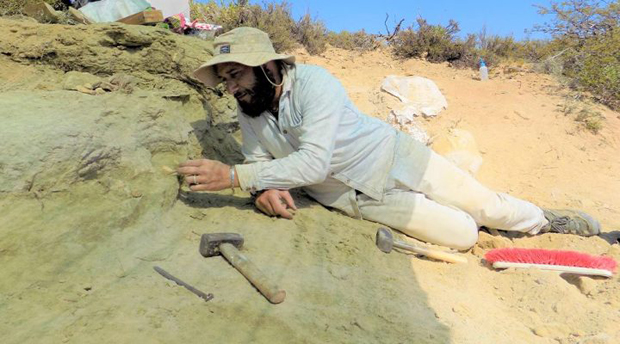
Dr. Andrew Farke at the Site of the Fossil Discovery (2007)

Dr. Andrew Farke, pointing out the first traces of the dinosaur fossil.

Dr. Andrew Farke, pointing out the first traces of the dinosaur fossil.

Picture Credit: Denver Museum of Nature and Science

As with many dinosaur discoveries, this fragmentary specimen leaves more questions unanswered than answered but it has potentially provided important evidence linking Indian Abelisaurids and Madagascan Abelisaurids to a common ancestral form.

Everything Dinosaur is grateful to the Denver Museum of Nature and Science  for their help in the compilation of this article.

Oldest Dinosaur Embryos Discovered in China

Dinosaur Nesting Site May Have Yielded Ancient Organic Material

A dinosaur nesting site that has been dated to the Early Jurassic is providing a team of international scientists with an unprecedented insight into the growth and development of baby dinosaurs.  A scientific paper, published in the academic journal “Nature” and the cover story of this publication’s latest edition, also states that the research team may have discovered traces of organic remains.  If this is the case and the fossils have not been contaminated by more recent organic material, then this discovery marks the earliest known organic remains of a terrestrial vertebrate.

New Research into Baby Dinosaurs

New research into 190 million year old baby dinosaurs.

New research into 190 million year old baby dinosaurs.

Picture Credit: D Mazierski

The fossil site was discovered by Timothy Huang of the National Chung Hsing University (China) when he was exploring an area of Lower Jurassic aged strata in Yunnan Province (south-western China).  His preliminary investigations led to the discovery of a monotaxic bone bed (an extensive amount of fossil material all assigned to the same species).  The fossils consist of the remains of dinosaur embryos at various stages of development along with the remains of dinosaur egg shell.  The strata represents a dinosaur nesting site.

Fossilised dinosaur embryos are extremely rare in the fossil record.  The oldest known until the Chinese discovery, are believed to represent the Early Jurassic Sauropodomorph of the genus Massospondylus, these fossils were discovered in South Africa, back in 1976.  The South African fossil material was kept in storage for many decades and detailed research into these embryos and their ontogeny (growth rates) was published in 2010.

To read the Massospondylus article: Cracking the Mysteries of the Dinosaur Egg

The Chinese embryos represent another type of Sauropodomorph.  The joint Canadian/Chinese scientific team have assigned these beautifully preserved fossil remains to the genus Lufengosaurus.  This Early Jurassic dinosaur, closely related to the European Plateosaurus of the earlier Triassic Period, is known from more than twenty fossils of individuals. All these fossils have been found in the same geological formation as the newly discovered nesting site (Lufeng Formation).  Lufengosaurus, was a herbivorous dinosaur which may have reached lengths in excess of eight metres.  It was probably one of the largest dinosaurs living in this part of the world in the Early Jurassic (190-197 million years ago).

An Illustration of an Adult Lufengosaurus

Early Jurassic Sauropodomorph

Early Jurassic Sauropodomorph

Picture Credit: Everything Dinosaur

The initial investigation of the bone bed by Timothy, yielded more than two hundred embryonic fossil bones.  Realising the significance of his discovery he invited Dr. Robert Reisz who had worked on the South African embryo fossils to investigate.  Dr. Reisz and his team (University of Toronto), working with Chinese colleagues quickly identified that the fossils did not represent a single nest but a number of broods of young, with many at different stages of embryonic development.  This has permitted the team to study the growth and development of a single dinosaur species in great detail.  By comparing the femurs (thigh bones) of baby dinosaurs of different ages the team were able to suggest that these dinosaurs maintained a consistent and rapid rate of growth and development.  For example, the thigh bones of these dinosaurs more than doubled in size whilst still in the egg.  The team’s findings also indicate that Sauropodomorphs  had very short incubation times – the embryos grew quickly and hatched fast.

A Stained Cross Section of Embryonic Thigh Bone with Large Pore Spaces Indicating Rapid Growth

This stained sample of a thin cross section of femur suggests rapid growth.

This stained sample of a thin cross section of femur suggests rapid growth.

Picture Credit: A. Leblanc

Chickens hatch in about three weeks, whereas crocodile eggs hatch after approximately one hundred days.  The largest living lizard today, the Komodo dragon (Varanus komodoensis) has a much longer incubation period – over eight months.  In addition, tiny muscle scars on the miniature bones indicate that the muscles of these herbivorous dinosaurs were well developed.  This suggests that just like modern birds, baby dinosaurs moved around a lot inside their eggs.  Highly active muscles before hatching suggests that these dinosaurs were far from helpless when they hatched.  It is not known whether these Sauropodomorphs had a precocial habit, the babies being virtually independent from their parents at birth and able to fend for themselves.  Well developed muscles would have helped these young dinosaurs to escape from the nest, to avoid many potential predators and to start to find their own food.

The presence of such large numbers of fossil bones, free from the eggs in which they were formerly contained gave the researchers the opportunity to assess the growth rates of this type of dinosaur from a clade known for its gigantism.  However, the scientists also detected traces of organic remains in the fossil material, astonishing to think that such matter could have possibly survived for 190 million years or so.

Back in March, we reported on a joint Canadian and British research project which examined the fossilised remains of prehistoric camels in the High Arctic, although the bone found was extremely fragmentary and represented a tibia (lower leg bone), the research team discovered evidence of collagen present in the fossil.  By extracting a portion of the preserved organic material, scientists from Manchester University were able to prepare a “collagen fingerprint” and when this data was compared to the collagen from extant mammals it was found that the fossil specimen most closely matched the collagen found in camels.  This test helped to confirm that the 3.5 million year old tibia bone was from a prehistoric camel that once roamed high latitudes.

To read about the camel research: Camels of the Arctic

Dr. Reisz and his co-workers claim to have discovered locked deep inside the fossilised bones, evidence of collagen fibres, the main protein constituent of bone.  Organic material usually decomposes very quickly and to find potential evidence of organic material in Early Jurassic vertebrate remains is simply “astonishing” according to some commentators.

The research team hope that they may be able to collect some of this organic material.

He stated:

“We are opening a new window into the lives of dinosaurs.  This is the first time we’ve been able to track the growth of embryonic dinosaurs as they have developed.  The bones of ancient animals are transformed to rock during the fossilisation process, so to find remnants of proteins in the embryos is really remarkable.  If we can extract the collagen, then we can compare it to collagen in living organisms for further studies.  Comparisons can be very valuable in evolutionary studies.”

The potential discovery of such ancient organic material in tiny, delicate fossilised bones of embryos, especially when one considers the porosity of bone material has been described by Dr. Reisz as “mind boggling”.

The team hope that if they are able to extract a sample, other researchers such as the University of Manchester research team who analysed the collagen sample from the prehistoric camel, might be able to create a “collagen fingerprint”.  This would allow the prehistoric protein to be compared to the collagen of living vertebrates, perhaps once and for all cementing a link between the Dinosauria and Aves (birds).

The implications for this discovery may indeed be far reaching.  If the remnants of collagen can be found in such an unusual fossil sample, then it might be more common in the fossil record than previously thought.  If small bones could have preserved 190 million year old organic material then much more collagen could be lurking inside other fossil specimens.  This could revolutionise our understanding of the taxonomy of extinct species.

As Dr. Reisz commented:

“I suspect that if we start using this methodology elsewhere, we will find it [collagen] more frequently than we think.”

Fossilised Feathers Helping to Identify the Colour of Dinosaurs – It’s a Bit of a Blur

Shape of Melanosomes and Hence Plumage of Dinosaurs Questioned 

Over the last couple of years or so, a number of scientific institutions have published academic papers revealing evidence of melanosomes preserved in fossil specimens.   As the shape and structure of these microscopic fossil features can provide evidence of the pigmentation and colour of an organism, the geometry of these melanin-loaded specialised elements within a cell, effectively acts as a colour chart for the animal the fossils represent.

Feathered Microraptors – Still Uncertain Regarding Colouration

New research casts doubt over previous colour claims.

New research casts doubt over previous colour claims.

Picture Credit: Everything Dinosaur

Perhaps one of the most famous fossils of all, material ascribed to the Late Jurassic transitional bird/reptile fossil known as Archaeopteryx (Archaeopteryx lithographica) has had melanosome evidence presented.  In this case, a single feather preserved in the fine grained lithographic limestone of the area suggested that the tip of the feather may have been coloured black.  The research was carried out in 2012 and undertaken by a team from Yale University, Brown University, the Carl Zeiss Laboratory (Germany) and the University of Akron (Ohio, United States).  Using extremely high-powered microscopy, the international research team identified the colour of a single fossilised feather, very likely from an Archaeopteryx.  They concluded that the feather, most probably a wing feather was black at the tip.  Their conclusions were based on the geometry (shape) of the remains of melanosome structures that they had observed.

To read more about the Archaeopteryx research: Archaeopteryx – Back in the Black

However, the colour of Archaeopteryx or any other animal in the fossil record with preserved evidence of melanosomes is not quite as “black and white” as it seems.  A new paper, published in the scientific journal “Biology Letters” suggests that over millions of years, the shape and structure of the melanosomes can be distorted under heat and pressure and the fossilised shape may not have much of a resemblance to the structure of these pigmentation organelles when the organism was alive, and in the case of Archaeopteryx, flapping around.

Debate Likely to Continue over the Colour of Archaeopteryx

Getting into a flap over the colour of feathers

Getting into a flap over the colour of feathers

Picture Credit: Carl Buell

The theory about melanosomes providing a guide to the colour of an extinct animal is on the surface very simple, but the trick, as with most aspects of palaeontology is the analysis of the data.  Melanosomes contain melanin and these specialised cell structures are present in skin, hair and feather cells.  The colour of the melanosome relates to a specific pigment.  Although the fossilisation process may have degraded all signs of actual colour, the ghostly shapes of the melanosomes themselves are often visible using specific lighting and optical devices such as high powered electron microscopes.  The preserved size, layout and shape can give palaeontologists some suggestions about the original colour in the organism.

Maria McNamara et al (University of Bristol), have published a study which suggests that the properties of melanosomes preserved in such fossils as the remains of dinosaur feathers, could become distorted and therefore provide scientists with misleading clues as to the original colour.  Under Professor Mike Benton (University of Bristol), some of the initial research into the colour of feathered dinosaurs was undertaken.  Professor Benton, in collaboration with Chinese colleagues provided evidence of the first colouration of a member of the Dinosauria back in 2010, when it was announced that the cursorial Chinese Theropod Sinosauropteryx may have been ginger.

To read more about the potential colouration of dinosaurs: Ginger Dinosaurs?

Maria and her fellow researchers mimicked the fossilisation process of feathers by simulating burial by placing modern-day bird feathers into an autoclave and then subjecting them to temperatures in excess of 250 degrees Celsius.  The chamber which held the experiment, was pressurised to 250 atmospheres, the intense heat and extreme pressures would be similar to the forces applied to strata and the fossils within them over millions of years.

When the melanosomes were studied under high magnifcation, the structure and shape of many of them had changed.  In effect, they had become distorted and withered.  This could lead to misinterpretations of fossil material if the melanosomes found preserved were taken at face value.

Ryan Carney, a research scientist based at Brown University, one of the team members who worked on the Archaeopteryx case study, black feathers and all, commented that shrinkage had been taken into account when he and his co-workers prepared their Archaeopteryx paper.  Their black feather conclusion was based on observations made using hundreds of melanosome structures that the team studied under very high magnification.  Although, the melanosomes may shrink a little during the fossilisation process, their original shape can still be determined by examining an imprint left in the matrix by the organelle (organelle – specialised area of a cell with specific functions).

Referring to the Archaeopteryx study he stated:

“We found that the length and width of melanosomes were significantly smaller compared to those of the imprints, the shrinkage was actually quite similar to that of the McNamara et al experiment”.

McNamara and her team remain confident in the validity of their data and they have provided intriguing evidence which requires careful analysis in the light of the current research.  For example, another important conclusion from this research is that melanosomes survive the heat and pressure of fossilisation even after the destruction of other non-melanin colour traces such as carotenoids (organic pigments, responsible for example for the colour of carrots and apricots).  Carotenoids can create vivid shades of orange, green, yellow, red and blue in feathers, however, in the University of Bristol experiments the multi-coloured feathers tested gave results indicating that they were just black.  This was because their non-melanin organic pigments had been destroyed and only the melanosomes survived to give the false reading of black.

With this conclusion in mind, the discovery of melanosomes in a fossilised feather such as that from a 150 million year old specimen such as Archaeopteryx might not necessarily mean that the original feathers were coloured black, reddish or brown.

McNamara commented:

“The bottom line is that until we understand how the fossilisation process affects these colour-producing chemicals and structures, and until we know how to look for evidence of these in fossils, there’s really no point in attempting to reconstruct colour of feathers based on melanosomes alone.”

Being able to determine the colour of an extinct animal would be very helpful in trying to work out its behaviour or how it reacted to its environment.  Knowing the true colour of a Velociraptor for instance, would enable palaeontologists to assess how it camouflaged itself or used visual signals to communicate with other members of its kind.  If a number of fossil specimens of different aged individuals could be studied, scientists might be able to see how the colouration changed as the animal grew, what differences there may have been between males and females etc.

Examining a Highly Magnified Image Showing Melanosome Structures

Interpretation of melanosomes.

Interpretation of melanosomes.

Picture Credit: Brown University

The Archaeopteryx study also led to some conclusions related to the development of avian flight.  The melanin in the wing feathers may not only have provided colouration but also helped to increased the strength of the feather, very helpful to have strong feathers with core strength if you are trying to evolve into a more active and efficient flier.

There is still so much to learn about fossils, new techniques and new areas of research are providing some astonishing data but we still have a long way to go before we can say definitively what colour a feathered dinosaur may have been.

Carboniferous Crinoids Provide Evidence of Oldest Biomolecules Directly Isolated from Fossil Material

Study into 350 Million Year Old Echinoderms Reveals Presence of Biomolecules

America some 350  million years ago looked very different than it does today.  For starters, much of the land mass which we now know as the United States formed part of a super-continent called Laurentia, but a considerable portion of the USA was covered by a warm, shallow tropical sea.  Scientists from Ohio State University have been studying an unusual phenomena associated with Crinoid fossils from strata deposited in an ancient marine environment in the American Midwest and their research reveals that complex organic molecules may have been preserved.  It had been thought that organic molecules could not survive the fossilisation process and remain present in fossil material after immense periods of time, but a number of recent studies using the most sophisticated analysis techniques ever to be employed in palaeontology are challenging  this assumption.

Crinoid fossils preserved in rocks from the American Midwest (specifically Indiana, Ohio and Iowa), the remains of animals that lived during the Mississippian Epoch (Carboniferous), can be preserved in different colours depending on the species.  Different species of Crinoid, preserved in the same matrix, the same fossil slab, can be blueish grey, creamy white or even dark grey when observed under natural light.  Scientists had commented on this bizarre phenomenon over a hundred years ago, the fact that the Crinoid fossils found in some parts of the Midwest seemed to be colour coded, but it took a team of geologists and scientists from the Ohio State University to get to the bottom of this mystery.

An Example of the Different Coloured Crinoid Fossils Used in this Study

Revealing 350 million year old organic compounds.

Revealing 350 million year old organic compounds.

Picture Credit: Professor William Ausich, courtesy of Ohio State University.

Crinoids are members of the ancient Phylum known as Echinodermata (Echinoderms) – starfish, brittle stars, sea urchins and crinoids (sea-lilies).  Their fossil record dates back to the Cambrian.  Crinoids are often referred to as sea-lilies, as they superficially look like plants.  The fossil record for Crinoids dates back to the Early Ordovician and there are a number of genera living today, including forms with stems that live attached to the sea-bed filling an ecological niche once filled by the Carboniferous Crinoids.

Most prehistoric Crinoids were attached to the sea-bed by a stem or a stalk, with a root-like holdfast at the bottom.  The mouth and the digestive tract was located in an enclosed cup at the top of the stem.  A series of feathery appendages which were covered in tiny, thin plates (pinnules) acted as a food gathering mechanism.  The sea current brought particles of food which were caught by the pinnules on the arm-like appendages and these food items were than wafted into the mouth.  The hard parts of the animal were formed of calcium carbonate (calcite), extracted from the surrounding sea water.  This calcite was porous and a thin skin of living tissue covered these hard parts.  Calcite is often very well preserved in the fossil record and the calcite plates that make up the flexible stem of these sea creatures are common fossils in Palaeozoic and Mesozoic aged marine, sedimentary deposits.

A series of dramatic storms seem to have devastated the sea-bed where vast colonies of these sea-lilies thrived.  The sea-floor became choked in finely grained mud.  Once these Crinoids were buried they were no longer able to feed and vast numbers of them were wiped out.  Being rapidly buried, quickly isolated from scavengers and oxygen to speed up the degradation process the calcite skeletons were preserved in beautiful detail, many of which remain articulated.  The porous calcium carbonate elements of the animal gradually became filled with minerals and preserved as fossils, however it seems that some of the pores that once contained living tissue were sealed so completely that traces of the molecules that made up the living tissue of the organism may have been preserved.

A Palaeozoic Marine Environment (Wemlock/Silurian)

Crinoids are the tall flower-like structures seen on the extremes of this illustration.

Crinoids are the tall flower-like structures seen on the extremes of this illustration.

Picture Credit: Open University

The University based research team were able to extract organic molecules from the individual sea-lily fossils.  They discovered that different species contained different organic molecules.   Some of these ancient sea creatures, that had died during these storm events, although they lay next to other species of Crinoid  and had become preserved in the same slab of sedimentary rock: the different species were preserved in different colours – the greys, creams and blue-greys.

The organic molecules, referred to as biomarkers were extracted using a gas chromatograph mass spectrometer.  Tiny samples were taken from the individual fossils, these were then dissolved into a solution.  This liquid and its contents was analysed by the gas chromatograph mass spectrometer and individual molecules were identified based on their mass and their electric charge.  A computer programme was used to sort the data and to find a match in living Crinoid species for the organic molecules recovered.  The software identified these biomarkers as being similar to quinones found in Echinodermata.  These quinones are aromatic, organic compounds that are found in a number of organisms, they are associated with pigmentation (the colour of an animal) or in the production of toxins and other unpalatable substances that deter predators from attacking.

Professor William Ausich, of the School of Earth Sciences (Ohio State University) and  a co-author of the academic paper that has just been published in the scientific journal “Geology” stated:

“There are lots of fragmented biological molecules—we call them biomarkers—scattered in the rock everywhere.  They’re the remains of ancient plant and animal life, all broken up and mixed together.  But this is the oldest example where anyone has found biomarkers inside a particular complete fossil.  We can say with confidence that these organic molecules came from the individual animals whose remains we tested.”

Christina O’Malley in conjunction with the Ohio State geochemist Yu-Ping Chin, confirmed that the quinone-like molecules occur in fossil Crinoids as well as in their extant descendants.  Although different coloured fossils do contain different quinones, the research team stressed that there was no definitive evidence to suggest that the preserved molecules were directly associated with the extinct creatures colouration.

The researchers hope to be able to extract more organic material from the fossils in a bid to find out as much as they can about each individual species.

Explaining that these molecules did not represent genetic material such as DNA, Professor Ausich commented:

“We suspect that there’s some kind of biological signal there, we just need to figure out how specific it is before we can use it as a means to track different species.”

It is truly astonishing that these gregarious, benthic (living on the sea-floor), animals from the Palaeozoic can reveal traces of organic compounds when their fossilised remains are analysed.

Cretaceous Mass Extinction Event Most Accurate Date Established

International Team Establish Most Accurate Date Yet for Extraterrestrial Impact

If you were able to travel back in time, one part of Earth’s history that would be best avoided would be 66,038,000 years ago plus or minus 11,000 years, as this period has been identified by a team of international researchers as being the time of the impact of a huge object from space that aided the extinction of the Dinosauria and the demise of about seventy percent of all land animals.

Scientists from the Berkeley Geochronology Centre (University of California), in co-operation with colleagues from Glasgow University and Vrije University (Amsterdam, Holland), have concluded that an asteroid, meteorite or possibly even an object such as a comet collided with the Earth approximately 66.038 million years ago.  Although this single event may not have been the cause of the mass extinction, the scientists conclude that if the extraterrestrial impact was not wholly responsible, it would have contributed significantly to the global extinction event.  Based on the dateline evidence that the team established, the impact of a large extraterrestrial object in the Gulf of Mexico area could have proved to have been the final blow that saw off the Dinosauria, marine reptiles and Pterosaurs.

Commenting on the research, which has just been published in the academic journal “Science”, one of the Californian based authors of the paper stated that the extinction and the impact are synchronous to each other and therefore it is highly probable that the impact played a major role in the mass extinction.  In essence, the impact from outer space and the subsequent environmental and climatic chaos that followed, may have been the “tipping point” for the dinosaurs, finally leading to their extinction.

Accurately Dating the Late Cretaceous Earth Impact Event

A contributory factor in the mass extinction?

A contributory factor in the mass extinction?

It was father and son Luis and Walter Alvarez who first published a theory (1980), stating that a thin layer of clay enriched with the rare Earth element iridium found at the boundary between Uppermost Cretaceous strata and younger Cenozoic deposits marked the impact of a large, extraterrestrial object.  It was these two American scientists who first claimed that this was evidence of a meteorite or some other object from outer space colliding with the Earth.  Although the American scientists did not know where the impact actually occurred.  This was resolved when the Chicxulub crater, a geological feature that had been first identified in the 1970s, was more thoroughly examined in the 1990s and it was established that this feature had been created around the time of the end of the Cretaceous.  The object, measuring around ten kilometres in diameter and travelling at around thirty kilometres a second smashed into the Gulf of Mexico, close to what is now the village of Chicxulub on the coast of Mexico’s Yucatan peninsula.

The impact was cataclysmic, some scientists estimate that the collision released energy equivalent to 100 million hydrogen bombs.  A crater was blasted into the Earth more than 100 kilometres wide and up to 12 kilometres deep.  Virtually all life within thousands of miles of the impact zone would have been annihilated almost immediately.  Some 50,000 tonnes of rock was thrown up into the Earth’s atmosphere and huge quantities of sulphur was released, which when mixed with water droplets then fell to Earth as vast amounts of dilute sulphuric acid (acid rain), destroying what vegetation had survived the earthquakes, tsunamis and wildfires.

This new research helps to clarify any potential concerns over the timing of this catastrophic event in the history of life on Earth.  This event seems to have taken place at around the time of the mass extinction, not a long time before or indeed after the extinction event.  The impact and the mass extinction seem to be contemporaneous with each other.

Some scientists have argued that there may have been two extraterrestrial impacts at or around 65-66 million years ago, whilst others have provided evidence to suggest that the dinosaurs and other large, land vertebrates lived for approximately 300,000 years after the impact event.  This new research may not end the debate on the Cretaceous mass extinction event but at least it allows scientists an opportunity to build up a more accurate timeline of events at the very end of the Age of Dinosaurs.

Tektites, glassy spheres of molten rock that had been created at the moment of impact and hurled up into the atmosphere to later fall to Earth formed an important element in this new dating study.  If this material along with other elements that make up the famous K-T boundary between Mesozoic aged and Cenozoic aged deposits could be dated accurately then a more precise date for the actual impact could be established.  Part of the scientific team travelled to Haiti to collect tektites whilst other researchers explored the Upper Cretaceous sediments such as volcanic ash laid down in the famous Hell Creek Formation of Montana (United States).  Samples were gathered and analysed in laboratories using a dating technique called “argon to argon dating”.

The samples were analysed in laboratories in the United States, “argon-argon dating” was used to determine their ages more precisely.  Argon-argon dating is a form of radiometric dating.  Radioactive elements decay and have isotopes which allows scientists to date the formation of certain elements within igneous rocks, thereby making it possibly to establish a chronology of the Earth’s history.  This dating technology uses the fact that naturally radioactive potassium decays into argon at a very regular rate.  Determining the ratio of these two elements in a sample provides a geophysicist with a method of calculating the age of the sample material.

University of Glasgow researchers conducted their own independent analysis of the samples and they confirmed the results of the American research team, thus the researchers were able to establish a new, more accurate date for the Yucatan impact.

The team are keen to point out that this single, terrible impact event was not the sole cause of the mass extinction.  Towards the end of the geological period known as the Cretaceous there seems to have been a number of other factors in play all contributing to climate change.  The sustained and immense volcanism which occurred in what was to become India would have had a major impact on the Earth’s climate.  The enormous basaltic lava flows of western and central India – known as the Deccan Traps, indicate that the most violent and devastating eruptions are dated very closely to the mass extinction event.  This geological activity would have had a significant impact on the Earth’s climate and this activity could have been a causal factor in the mass extinction.  The international research team hope to be able to use the argon-argon dating techniques to accurately map and date the Deccan Traps.  In doing this, the team will be helping to build up a more complete picture of the series of events that led to the demise of the dinosaurs.

To read an article that explores the possible range of contributory factors involved in the Cretaceous mass extinction event: Exploring the Cretaceous Mass Extinction

Ichthyostega Gets a Re-Think

New Research Suggests Earlier Reconstructions had the Backbones “Back to Front”

The fossils of the early Tetrapod Ichthyostega, the first Devonian Tetrapod to be discovered, have always puzzled scientists. This one and a half metres long transitional creature between a fish and a land-dwelling amphibian has always courted controversy and a new study suggests previous attempts to model the vertebrae may have been inaccurate.  In effect, the backbone in skeletal reconstructions of this creature may have formerly been “back to front.”

Tetrapods (the name means “four feet”), are in essence, the limb-bearing vertebrates with four limbs and distinct digits.  Human beings (H.sapiens), are members of the Tetrapod group.  Scientists agree that the Tetrapods evolved from fish and the first of these creatures evolved during the Devonian geological period but exactly what group of fishes gave rise to the Tetrapods and when remains open to some debate.

Ichthyostega had four limbs, in earlier models this animal was pictured as being well suited to life on land with its robust limbs holding the front portion of the body clear of the ground.  It is now thought that the first Tetrapods were not so well adapted to a life out of the water and it is likely that if these animals did venture out onto land they would not have been capable of lifting their body weight up, most probably just dragging their bodies along rather than lifting them clear of the land surface.

An Early Interpretation of Ichthyostega

An older interpretation of Ichthyostega

Picture Credit: Everything Dinosaur

Professor Jenny Clack (University of Cambridge), a world-authority on early Tetrapods in conjunction with her colleague Dr. Stephanie Pierce (Royal Veterinary College (London), has published new evidence that provides a fresh insight into the Ichthyostega genus.  These distinguished scientists reaffirm that these animals may not have been that well adapted to terrestrial life after all.  It is known that Ichthyostega and its near relative Acanthostega had large teeth and that they were predators, what is unclear however, is whether these animals hunted on land or in the water.

The European Synchrotron Radiation Facility in Grenoble (France) was employed by the researchers to bombard three fossil specimens of Ichthyostega with very powerful X-rays.  These X-rays once interpreted by sophisticated computer software were able to reveal more details regarding the structure of this Tetrapod’s skeleton.  The three-dimensional images of the fossil material the research team was able to produce revealed something very surprising.  It had been thought that the back bones of early Tetrapods were comprised of four separate bones arranged with one at the front, one just behind the first one and a pair towards the rear of each element of the vertebrae.  The images, that the team produced showed that in the case of the Ichthyostega fossils, the bones at the back had become fused to the one at the front.  This discovery revealed that the first “anterior ” bone at the front of the four bone series was actually the posterior one (at the back).  The change in the orientation and the relationship between the bones in the spine would change the way in which this early Tetrapod could move

Writing in the academic journal “Nature”, Dr. Pierce explained:

 ”Ichthyostega made us open our minds, stand back and reassess the anatomy of other early Tetrapod fossils.  When we did this, it was obvious that the bones of their spines were also in the reverse order than what had previously been described.”

In addition, the application of new research techniques has enabled the scientists to spot evidence of a primitive sternum in this Devonian animal.  The sternum consists of a series of bones that are aligned together and run down the centre of Ichthyostega’s chest.  This suggests that the animal’s body weight was supported by the sternum and that the limbs did not hold the body clear of the ground as shown in much earlier illustrations of Ichthyostega, but instead this animal probably moved on land by dragging its body along by moving its front limbs.  This method of locomotion is seen today with the Mudskippers (fish from the family Gobiidae).  These Gobies are able to haul themselves around on land using their sturdy pectoral fins as simple, efficient forelimbs.

The Latest Interpretation of Ichthyostega

Ichthyostega interpreted dragging its body across the ground

Picture Credit: Julia Molner

The research team hope to be able to analyse the vertebrae of other Devonian Tetrapods using the European Synchrotron Radiation Facility so that a more detailed understanding of the evolution of terrestrial locomotion can be obtained.

Three Dimensional Printing Proving Beneficial to Palaeontologists

Producing Three-Dimensional Fossils Using Resin

Palaeontology may still be very much a case of using your eyes to spot fossils and such fossil prospecting is always going to be an important part of this Earth science but more and more technology is being employed to give palaeontologists an insight into the fossil specimens that they find.  The advent of affordable three-dimensional printers that can produce an object from scanned images is helping scientists to produce copies of the fossils they discover and allowing them to share their discoveries with other museums without having to go to the expense of using conventional casting techniques.

Palaeontologists working at the museum of Natural History in Rio de Janeiro (Brazil), have invested in a portable CT scanner to help them determine what fossil material may be contained in an individual block of stone that they excavate.  Even locating fossils, has become much easier with ground penetrating radar providing field teams with information about the orientation of any fossil specimen in the ground.  The images this radar can produce thus guides the excavation team and helps with the safe removal of any matrix material, after all, one careless blow with a geological hammer could damage a precious and rare fossil beyond repair.

Once the location and position of a fossil has been calculated, circular saws can cut out a section of rock, the block, which may represent Cretaceous sediments from the famous Santana Formation of eastern Brazil is then subjected to a further aspect of 21st Century technology – three-dimensional CT scans.  Portable CT scans (computerised tomography), permit the block to be penetrated by powerful X-rays which can be analysed by computer to produce information about what fossils are present in the individual block.  This work is usually carried out in the safety and relative comfort of the museum’s preparation lab.

This data from the 3-D scan can be analysed by one of the new three-dimensional printers and within hours a replica of the object can be printed out using resin.  The scientists can have their own fossil replica to help them study the delicate structures of any fossil that they find.

The combination of CT scans and three-dimensional printers is helping to change the study of ancient animals.  Already the Brazilian team have used this combination of technologies to gain a better understanding of a fossilised snake and a crocodile skull dating from the Late Cretaceous.

Examining the Structures of a Crocodile Skull in Three Dimensions

New Technology meets Cretaceous Crocodile

Picture Credit: Sergio Azevedo

Commenting on the use of these new techniques, Sergio Azevedo of the Natural History Museum of Rio de Janeiro stated:

“We are developing several research lines in palaeontology using CT and surface 3-D scanning.  These include the nervous system and biomechanics of crocodiles, dinosaurs and other vertebrate fossils.”

This is a non-destructive technique and with prices of three-dimensional printers likely to come down over the next twelve months or so, more museums, universities and even schools can gain access to this technology.  The 21st Century is seeing a cross-over of technology from different scientific disciplines providing palaeontologists with the opportunity to create accurate, highly detailed replicas of the fossils they discover.

Staypressed theme by Themocracy