Category: Dinosaur and Prehistoric Animal News Stories

Flim Star Honoured by Having Fossil Arthropod Named After Him

Edward Scissorhands (Johnny Depp) Honoured by Having Cambrian Arthropod Named After Him

The 1990 film Edward Scissorhands (directed by Tim Burton), starred Johnny Depp as a boy with scissors for hands.  A new genus of Cambrian Arthropod, a strange four centimetre long creature that is distantly related to extant, marine Arthropods such as crabs and lobsters, which also had scissor-like appendages has been named in honour of the actor.

Naming a new creature after a famous person is nothing new, for example, a number of dinosaurs have been named after wealthy benefactors and people who have supported the sciences.  Back in 2011 a new species of horned dinosaur, Pachyrhinosaurus perotorum was named in recognition of the Perot family (Margot and H. Ross Perot), for their support of the Museum of Science and Nature in Dallas, Texas.  The author Herman Melville, he of “Moby Dick” fame has had a species of toothed whale named after him, but it is rare for an actor portraying a fictional character to be honoured in this way.

The animal has been named Kooteninchela deppi (pronounced as Coo-ten-ee-che-la depp-eye).  The fossil has been dated to around 505 million years ago (Late Cambrian).  It was during the Cambrian period that virtually all the pre-cursors to modern animals evolved.  Author of the scientific paper, published this month in the academic publication “The Journal of Palaeontology”, David Legg  commented that:

“When I first saw the pair of isolated claws in the fossil records of this species I could not help but think of Edward Scissorhands.  Even the genus name, Kootenichela, includes the reference to this film as ‘chela’ is Latin for claws or scissors.  In truth, I am also a bit of a Depp fan and so what better way to honour the man than to immortalise him as an ancient creature that once roamed the sea?”

An Illustration of Kootenichela deppi

Strange, clawed Cambrian Arthropod.

Strange, clawed Cambrian Arthropod.

Picture Credit: AFP/Getty Images

Scale Bar: Everything Dinosaur

The fossil, which comes from Canada, (British Columbia), represents an animal that lived in warm, shallow waters part of a rich and diverse marine ecosystem dominated by Molluscs and Arthropods with the very first ancestors of the Chordates (animals with backbones), playing only a minor role.

K. deppi  had a flattened, segmented body with pairs of legs associated with the majority of its trunk segments.  It probably scuttled along the sea floor but was probably capable of swimming short distances by flexing its body from side to side.  It is not known what the scissor-like appendages were used for.  This Arthropod that lived alongside the Trilobites, may have scavenged the carcases of other creatures that had died and sank to the bottom of the sea.  Or perhaps, it used its strange claws with their elongated spines to probe in the sediment so as to capture soft-boded creatures like segmented worms.  Like many Cambrian Arthropods, it has large compound eyes, with each lens made of calcite.  Each eye was positioned on top of a movable stalk (a peduncle).  This would have given this two inch long Arthropod excellent vision, even in low light and it could have buried itself in soft mud, leaving its eyes sticking out so that it could keep a look out for any predators whilst remaining difficult to spot.

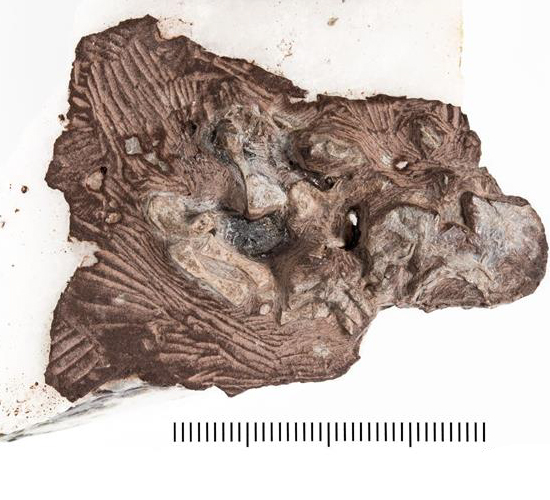
A Close up of the Strange Claw-like Appendages

Are these the offensive weapons of a predator?

Are these the offensive weapons of a predator?

Picture Credit: Imperial College/Journal of Palaeontology

David’s research led him to conclude that Kooteninchela deppi belongs to a group known as the ‘great-appendage’ Arthropods, or Megacheirans, (big hands), which refers to the enlarged pincer-like frontal claws that they share.  The Megacheirans are a diverse clade, fossils of which have been found in many parts of the world including the famous Burgess Shale deposits and Cambrian aged strata in China.

David went onto state:

“Just imagine it: the prawns covered in mayonnaise in your sandwich, the spider climbing up your wall and even the fly that has been banging into your window and annoyingly flying into your face are all descendants of Kooteninchela deppi.  Current estimates indicate that there are more than one million known insects and potentially 10 million more yet to be categorised, which potentially means that Kooteninchela deppi has a huge family tree.”

The researcher hopes to extend his study of ancient Arthropods with the aim of learning more about the radiation of these armoured creatures and how ancient Arthropods gave rise to the huge range of extant Arthropods found today, including the insects.

It seems that the inspiration behind Edward Scissorhands was not a first, such a creature with claw-like appendages had evolved some five hundred million years earlier.

Doting Dinosaur Dads – Might Not Be the Case

Male Dinosaurs May Not Have Looked after the Nest After All

Back in December 2008, Everything Dinosaur published details of an academic paper that concluded that male Theropod dinosaurs undertook the majority of the brooding of eggs in nests.  Dr. David Varricchio (Montana State University) and his colleagues assessed the known nest fossil material of three Theropod dinosaurs from Upper Cretaceous strata.  The dinosaurs studied were Citipati osmolskae, Oviraptor philoceratops (both Oviraptorids) and Troodon formosus (Dromaeosaurid – whoops corrected Troodontid).  The team used a number of methodologies to conclude that, just like 90% of the birds species alive today, it was the male Theropods who did most of the brooding on the nests.  The conclusions were reached after examining fossils for evidence of bone cavities associated with the loss of calcium from the body in order to produce egg shell.  Such cavities would be expected to be seen only in females.  Since none of the fossil bones included in the study showed such cavities, it was suggested that the individual dinosaurs found in close proximity to a nest of their own species were probably male.

A Close up of a Theropod Dinosaur Nest

New study casts doubt on the "doting dinosaur fathers" theory.

New study casts doubt on the “doting dinosaur fathers” theory.

The number of eggs laid per nest compared to the body size of the adult dinosaur supported this view that the brooding dinosaurs were male.   The study proposed that Theropod dinosaurs produced unusually large numbers of eggs per nest for their body size.  This pattern is often seen in extant Aves (bird species alive today), when the male alone takes on the parental duties.  The female can afford to lay more eggs, as she will not be looking after them so she can be away from her maternal duties and get back to feeding herself up to replenish lost reserves in her body.  So it was concluded that the Theropod males brooded the nest and probably played a significant role in looking after the hatch-lings.

To view an article on the original research: Doting Fathers – A Dinosaur Trait Passed Onto Birds

However, scientists from the University of Lincoln (England), have reviewed the data used in the 2008 study and they have come up with a different interpretation of the fossil evidence.

It is very difficult to infer behaviour, especially something as complicated as parental behaviour with just the fragmentary fossil record to go on.  In the review of the 2008 research, a number of factors known to affect egg and clutch sizes in living bird species were not taken into account.  A new scaling analysis of the clutch masses of birds suggests that the type of parental care may not be inferred.  The evolutionary relationship between the Theropods and Aves may be widely accepted but this does not necessarily mean that these two types of creature raised their young in the same or similar ways.   The maturity of the hatch-lings precocial (independent  young) or altricial (dependent young) would have a significant bearing on the behaviour of the parents.  Intriguingly, the new study from the University of Lincoln team suggests that most Theropods seem to exhibit precociality (hatch-lings born relatively mature and independent to a degree from their parents).

The male Theropod dinosaurs may not have been such dedicated dads after all.

Dr. Charles Deeming (School of Life Sciences) and his Lincoln University colleagues point out a number of factors that need to be considered before attempting to work out how adult Theropods behaved around the nest.  Dr. Deeming specialises in the study of avian and reptilian reproduction, he is very well placed to compare extinct fauna with extant descendants.  For example, a number of bird species today, deliberately lay their eggs in another bird’s nest so as to avoid any form of parental responsibility at all.  This will distort the size of some nests, Theropod dinosaurs may have behaved in the same way.  There are evolutionary advantages when it comes to getting others to do work for you.

Oviraptorid Nests were Part of the Study

Dinosaur nests carefully examined.

Dinosaur nests carefully examined.

Picture Credit: Cincinnati Museum Centre

Dr. Deeming and his team took a different approach to the statistical analysis.  They counted the eggs in all known fossil nests for the Theropod species included in the original study and then worked out an average clutch size for each species.  Dr. Varricchio and the Montana State University researchers had based their calculations on the largest clutch size for each dinosaur species.

When the British-based team compared their average figures with the adult dinosaur body mass, they found that the Theropod dinosaurs were not included in the group of male-only brooders.

Commenting on the earlier research, Dr. Deeming stated:

“The Varricchio analysis is now being used by other palaeontologists working on other dinosaur species.  It’s time to stand up and say it doesn’t quite work.”

For Dr. Varricchio, the new insight is most welcome, but he warns:

“Regardless of what this paper or our paper says, we are really operating with only a few pieces of the puzzle.  To address the [parental] care in these dinosaurs, one needs to consider their other relatives and not just birds.  For instance, crocodiles, which share a common ancestor with all dinosaurs, might be one source of clues to dinosaur brooding behaviour.”

The two research teams are agreed on certain points, there is a need for further study and looking at the nests of crocodiles may yield useful data.

Dr. Deeming added:

“If you look at the eggs in those dinosaur nests, they’re structure is similar to crocodile eggs.”

Crocodilians bury their eggs and the temperature at which the nest is kept is essential for healthy hatch-lings, the temperature of the nest also determines the sex of the offspring.  A buried nest hypothesis would add an additional and very significant factor to any parental behaviour study.

Dr. Deeming concluded by saying:

“Crocodiles don’t incubate their eggs, they just sit on the buried eggs to protect them from predators.  I think that’s probably what was going on in the dinosaurs too.”

It is difficult to assign behaviour to fossil material, in the absence of a time machine and an ability to travel back to the Late Cretaceous to observe Oviraptorids and Dromaeosaurs in the breeding season, this debate is likely to rumble on.

Fossilised “Fish Lizard” from Iraq Changing the Way we View Ichthyosaur Evolution

Ichthyosaur Evolution Just Got a Lot More Complicated

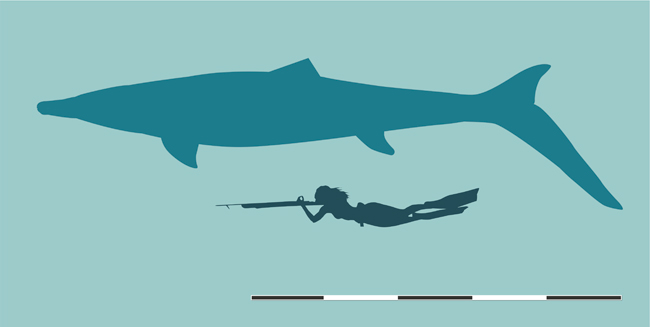
Ichthyosaurs were a group of marine reptiles that superficially resembled dolphins.  These streamlined, viviparous (giving birth to live young), predators seem to have evolved in the Early Triassic and became extinct towards the end of the Cretaceous.  Ichthyosaur fossils have been found all over the world, however, despite the wealth of fossil material (or perhaps because of it), there are a number of mysteries surrounding this Order that puzzle palaeontologists.  For instance, they do seem to be at least superficially, the best adapted to life in a marine environment when compared to the other types of marine reptile, the crocodile-like Metriorhynchids, the Mosasaurs, the long-necked Plesiosaurs and their shorter-necked relatives the Pliosaurs.  However, despite being very well suited to a nektonic lifestyle and there being a growing body of evidence to suggest that these types of “fish lizards”, were becoming better and better adapted to life in the open oceans as the Jurassic gave way to the Cretaceous, they still became extinct long before the Cretaceous mass extinction event that saw the demise of the other types of Late Cretaceous marine reptile.

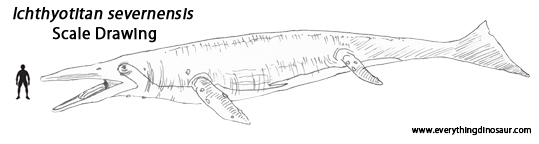
A Scale Drawing of a Typical Ichthyosaur

A typical "dolphin-like" Ichthyosaur.

A typical “dolphin-like” Ichthyosaur.

Picture Credit: Everything Dinosaur

The Order Ichthyosauria suffered a series of extinctions with three major extinction events identified over the duration of the Mesozoic.  As a result, those types of Ichthyosaur that survived into the Cretaceous from this Order’s Jurassic heyday were believed to a single branch of what had been a diverse clade.  The Cretaceous Ichthyosaurs were all relatively similar in their body plans and morphology and were believed to have shared a common Late Jurassic ancestor.  The lack of variation in Cretaceous Ichthyosaur body types, the general lack of diversity in the Ichthyosauria, was believed to have played a significant role in their ultimate demise during the Cenomanian faunal stage of the Cretaceous.

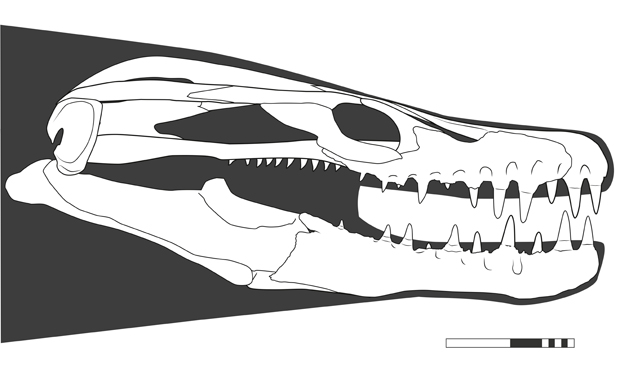
The publishing of a scientific paper (Biology Letters), outlining the research undertaken on a partial Ichthyosaur fossil specimen found in Iraq, may change the way in which the Cretaceous Ichthyosaurs are viewed.  This Ichthyosaur, named as Malawania anachronus (Mal-ah-won-nee-ah a-nack-kron-us), seems to contradict the long-held theories.  Malawania represents a “ghost lineage of Ichthyosaurs”, it resembles a more primitive form of this marine reptile Order, it does not appear to be closely phylogenetically related to other known Cretaceous Ichthyosaurs.

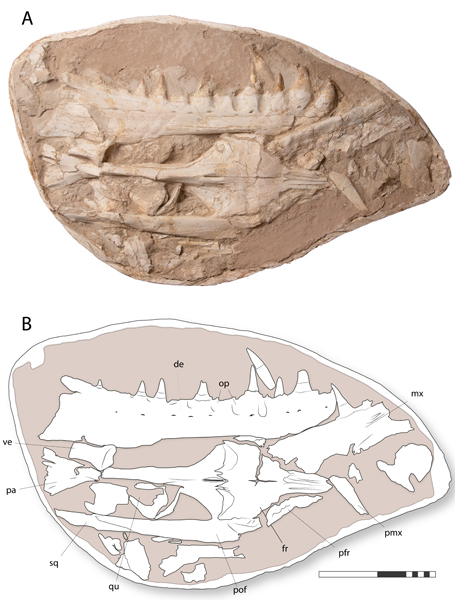
The fossil which consists of fragments of skull bones including a partial sclerotic ring (ring of bone around the orbit) and much of the front portion of the animal was discovered by British geologists exploring Kurdistan (north-eastern Iraq) in the 1950s.  At the time of its discovery, the slab of fossil material was not being treated with much reverence.  As one of the authors of the scientific paper outlining the study of this fossil, Dr. Darren Naish points out:

“Preserved within a large, flat slab of rock, it was being used as a stepping stone on a mule track.”

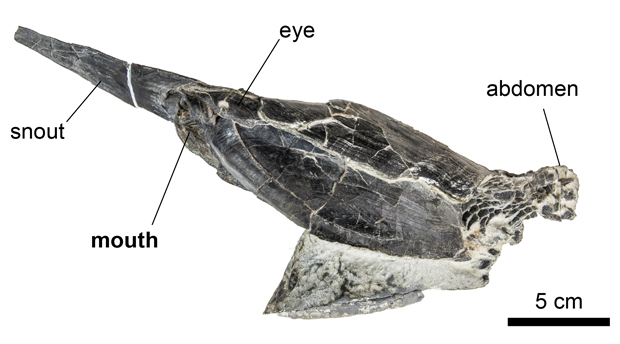
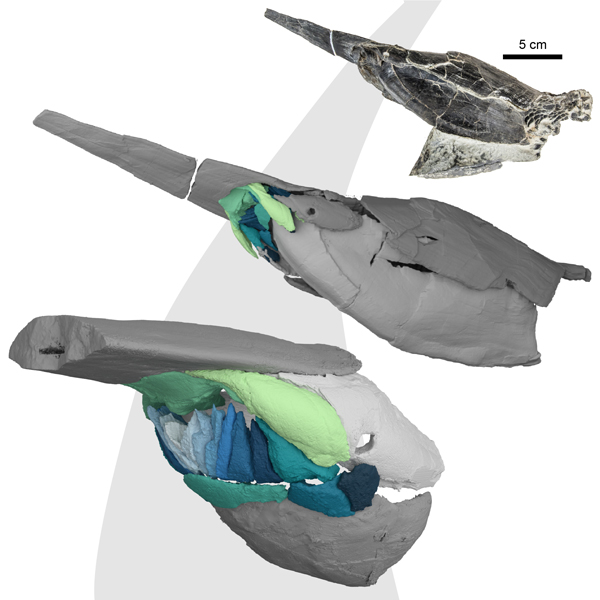
The Fossilised Remains of Malawania anachronus

The picture shows the fossil slab and a drawing illustrating the location of the fossil material.

The picture shows the fossil slab and a drawing illustrating the location of the fossil material.

Picture Credit: Biology Letters

Study of the specimen began during the 1970s with Ichthyosaur expert Robert Appleby, then of University College, Cardiff.  Although he recognised the significance of this fossil discovery, he unfortunately passed away before determining the precise age of the specimen.  However, the research into this strange Ichthyosaur, one of only two Ichthyosaur fossils known from the Middle East, was taken up recently by a team of international scientists and fittingly the contribution of Robert Appleby is acknowledged as he is credited on the list of authors for the scientific publication.

The research team conclude that this fossil contradicts the previous theories about the evolution and extinction patterns seen in the Ichthyosauria.  Lead author Dr. Valentin Fischer (University of Liege, Belgium) and his colleagues have named the specimen Malawania anachronus, the name means “out of time swimmer”, as despite being Cretaceous in age, the Ichthyosaur represents the last known member of a kind of Ichthyosaur which was believed to have become extinct during the Early Jurassic.  Analysis of the micro-fossils found on the slab of rock which contains the Ichthyosaur specimen, analysis of spores and pollen grains that have been preserved indicate that this Ichthyosaur lived approximately 125 million years ago (Barremian faunal stage of the Early Cretaceous).  The research team support this assertion by providing a cladistic study of the known Ichthyosaur fossil material to re-design the “Fish Lizards” family tree.  Here is evidence of a ancient, primitive Ichthyosaur assigned to the Thunnosauria group of Ichthyosaurs that seem to have originated in the Late Triassic.  This study suggests that in some parts of the world, primitive Ichthyosaurs survived relatively unchanged for more than sixty million years.

Commenting on the implications for this research, Dr. Fischer stated:

“Malawania’s discovery is similar to that of the Coelacanth in the 1930s: it represents an animal that seems ‘out of time’ for its age.  This ‘living fossil’ of its time demonstrates the existence of a lineage that we had never even imagined.  Maybe the existence of such Jurassic-style Ichthyosaurs in the Cretaceous has been missed because they always lived in the Middle-East, a region that has previously yielded only a single, very fragmentary Ichthyosaur fossil.”

The phylogenetic analysis undertaken by the research team suggests that several Ichthyosaur groups that appeared   during the Triassic and Jurassic geological periods may have survived into the Cretaceous.  This brings the extinction phases of the Ichthyosauria into doubt.  For example, according to this new study, the supposed end of the Jurassic extinction event may not have occurred.  The fossil record for the Ichthyosauria shows a very different pattern of extinction when compared to known, accepted data on other marine reptile groups.

The Evolution of the Ichthyosauria

A table compiled by the research team that explores the evolution and radiation of the Ichthyosauria.

A table compiled by the research team that explores the evolution and radiation of the Ichthyosauria.

Table Credit: Biology Letters

The position of Malawania anachronus is shown by the red line.  The chart at the top records the passage of time from the Middle Triassic to the Late Cretaceous and places known fossil material on this chronological scale.  The line graph below shows the proposed main periods of radiation of the Ichthyosauria and the herring bone diagrams at the bottom shows the proposed phylogenetic relationship between different genera.

When this research is taken together with the 2012 literature on the discovery of a new species of German Ichthyosaur known as Acamptonectes densus, another type of Ichthyosaur known as an Ophthalmosaur that may have survived into the Cretaceous, the discovery of Malawania revolutionises how palaeontologists view the evolution of this type of marine reptile.

To read more about this discovery: New Ichthyosaur Species Swims into View

There is growing evidence to suggest that the Ichthyosaurs remained an important and diverse group of marine reptiles, at least into the Early Cretaceous.  If this is the case, then their extinction some ninety million years ago becomes even more of a mystery.  Why did this diverse and seemingly superbly adapted Order of marine reptiles die out?

A spokesperson from Everything Dinosaur suggested:

“This new research certainly muddies the waters somewhat when it comes to the final demise of the Ichthyosauria.  If they had been a small, homogeneous group filling very similar niches in the food-chain of the oceans then they could have been very vulnerable to extinction.  However, this new evidence suggests that this was not the case, the Ichthyosaurs were more diverse than previously thought.  Perhaps the evolution and rapid radiation of the Teleosts (modern ray-finned fishes) had an effect, at this moment in time, it is a question of having to re-think accepted theories.”

 The Evolution of the “Fish Lizards” Shows that Something “Fishy” may Have Been Going On

The "Missing" Ichthyosaurus Model

More complicated than previously thought!

Picture Credit: Everything Dinosaur

As other areas of the Middle East are explored, perhaps more marine reptile fossils will be found and further evidence for the radiation and the eventual extinction of the Ichthyosauria will come to light.

Let’s Hear it for Our Hominid Ancestors

New Study into Fossilised Ear Bones Provides Information on the Evolution of Hearing in Early Hominids

The three bones that comprise the auditory ossicles (the bones of the middle ear that transmit sound vibrations to the cochlea), may the the smallest bones in the human body but they are having a big impact on the way in which anthropologists view the evolution of hearing in early hominids.

The term ossicles, means tiny bones, and this term is used to describe the malleus (hammer), incus (anvil) and the stapes (stirrup) bones, the three bones that make up the auditory ossicles, although in anatomy and other sciences such as palaeontology, ossicles can refer to any small bone.  A team of international researchers led by scientists from the Department of Anthropology at Binghamton University (New York, United States), have been able to compare and contrast the fossilised middle ear bones of a Paranthropus robustus to other fossil specimens such as additional ear ossicles from Australopithecus africanus.  The team’s findings suggest that the malleus (hammer) may not have changed much over millions of years but anatomical differences in the specimens of the other ear bones, the incus and the stapes, in conjunction with other morphological differences suggest that we modern humans, hear very differently than our ancient hominid cousins.  The research team conclude that modern humans (H. sapiens) have a different range of auditory capacities than these early hominid taxa.

The Oldest Hominid Auditory Ossicles in the Fossil Record to Date

Shedding light on the evolution of human hearing.

Shedding light on the evolution of human hearing.

Picture Credit: Texas A&M

The picture above shows the three middle ear bones of P. robustus, the stapes, the incus and the malleus.

The Anthropology Department at Binghamton University houses an extensive range of fossil casts of early hominids.  However, fossils of the auditory ossicles are only rarely preserved, their size and delicate nature often precludes them from any fossil preservation process.

The American team, assisted by colleagues from Italy and Spain examined a range of middle ear fossils, including a complete ossicular chain (malleus, incus and stapes) from a single individual specimen of Paranthropus robustus.  The fossils used in this study, including those from the P. robustus were discovered in the cave sites of Swartkrans and Sterkfontein in South Africa.  The dolomitic limestone that dominates the landscape of these areas is dotted with a large number of caves and many fossils of Late Pliocene hominids have been found.  These locations have been afforded UNESCO World Heritage Site status, such is their importance to palaeoanthropology.

Binghamton University anthropologist Rolf Quam and his colleagues were very keen to examine the middle ear bones unlike the vast majority of the  other 203 bones that make up a H. sapiens skeleton the auditory ossicles are fully formed at birth.    Babies and infants have technically more bones in their bodies than adults.  As we grow so these bones fuse together to give the 206 bones that are found in most human skeletons.  This means that any hominid fossilised auditory ossicles found would preserve the shape that they have always had, there would be no distortion in the data obtained from any study due to making allowances for fusing and growing of the bones when the individual was alive.  As the international team of researchers stated, the unchanging size and shape of the auditory ossicles suggest that these bones could harbour a wealth of evolutionary data, perhaps even providing an aid to scientists as they attempt to define more accurately our own evolutionary relationships with other hominids.

Comparing the Auditory Ossicles of Early Hominids

Comparing the malleus of P. robustus (top) to A. africanus (bottom)

Comparing the malleus of P. robustus (top) to A. africanus (bottom)

Picture Credit: R. Quam/PNAS

The research team noticed that the malleus (hammer) bone in the ancient hominids studied is very human-like.  It is very different in size and shape when it is compared to the malleus of extant apes such as gorillas.  The skull, teeth and jawbone of P. robustus for example, may be very ape-like, but the malleus is very similar to our own.  As Paranthropus robustus is believed to have represented a hominid sub-branch that did not lead directly to more advanced hominids such as Homo ergaster, Homo neanderthalensis and ultimately our own species, this research suggests that the shape and size of the malleus must have a very deep phylogenetic origin.  In other words, this trait could be traced back to a common ape/human ancestor deep into the Pliocene Epoch.

The incus (anvil) and the stapes (stirrup) in contrast, are much more ape-like.  This means that the auditory ossicles of ancient hominids show a combination of human and ape characteristics.   The research paper, published in the prestigious journal “The Proceedings of the National Academy of Sciences”, leads to an intriguing conclusion. If the shape of the auditory ossicles of ancient hominids were different from our own, then their hearing abilities are likely to have been different too.  This study lends support to the theory that these ancient hominids were not capable of producing speech as we do.   Certainly, they could communicate but based on the shape of their ear bones, these ancient human-like creatures may have struggled to pick up the range of acoustic frequencies that we use in everyday conversation.

Chimpanzees struggle to pick up the frequency of human speech, the evolution of the incus and the stapes could perhaps provide evidence of the development of human communication within the fossil record.  However, the paucity of the known fossil material rather excludes this possibility for the moment.

Commenting on the research, Assistant Professor Rolf Quam stated:

“Bipedalism [walking on two feet] and a reduction in the size of the canine teeth have long been held up as the “hallmark of humanity” since they seem to be present in the earliest human fossils recovered to date.  Our study suggests that the list may need to be updated to include changes in the malleus as well.  More fossils from even earlier time periods are needed to corroborate this assertion.”

New Species of Bone-headed Dinosaur Announced

The First of the Bone-heads

A team of North American scientists have announced the discovery of a new species of Pachycephalosaur.  Pachycephalosaurs are bird-hipped members of the Dinosauria commonly referred to as the bone-headed dinosaurs.  Pachycephalosaurids are known from Upper Cretaceous fossil bearing sediments of the northern latitudes, most notably from North America. Much of our knowledge about this group comes from a few well-preserved skeletons ascribed to the genus Stegoceras.  Other species have been identified based on the fossilised remains of their thickened skulls.  Indeed, so thick are the skull bones (frontal and parietal), that often these are the only fossils ascribed to a particular genera, the rest of the skeleton material presumably having been lost to erosion or failing to be preserved.

This new species, named Acrotholus audeti may be one of the oldest types of Pachycephalosaur discovered to date, certainly a candidate for the oldest Pachycephalosaur known from North America.  The genus name means “high dome” a reference to the thickened skull, whilst the specific name honours Roy Audet, on whose land the best-preserved specimen of skull material was found back in 2008.  The scientists from the Royal Ontario Museum/University of Toronto along with co-researcher Dr Michael Ryan, curator of vertebrate palaeontology at the Cleveland Museum of Natural History have used the example of this Pachycephalosaur to attest that there may have been many more different kinds of smaller dinosaurs than previously thought.  The team state that the fragile, lighter bones of smaller dinosaurs would not have survived to the present day, unlike some of the bones of their giant cousins.  In this way, the fossil record may be biased towards large dinosaurs and the small dinosaurs may be under represented.

The  Partial Skull Fossil of Acrotholus audeti (2008 Specimen)

The very thick skull of this new Pachycephalosaur.

The very thick skull of this new Pachycephalosaur.

Picture Credit: Royal Ontario Museum

Writing in the scientific publication, the “Journal of Nature Communications”, the research team describe their new dinosaur based on the remains of two skull domes, both from the Milk River Formation of southern Alberta (Canada).  The first specimen resides in the collection of the Royal Ontario Museum (Toronto), it was collected more than fifty years ago, the second specimen, the better preserved example, was discovered on rancher’s Roy Audet’s land in 2008.

The Site of the Dome Skull Discovery (2008)

The white arrow in the centre of the picture shows the location of the fossil find.

The white arrow in the centre of the picture shows the location of the fossil find.

Picture Credit: Journal of Nature Communications

The picture above shows the location of the 2008 fossil find, it has been marked by a small pile of rocks, the rucksack in the foreground provides scale.

The fossils have been dated to approximately 85 million years ago (Santonian faunal stage of the Late Cretaceous).  This makes the fossils ascribed to A. audeti some of the oldest Pachycephalosaur material known.  Palaeontologists remain uncertain as to where and when the first true Pachycephalosaurs evolved.  Certainly, sometime in the Cretaceous a group of small, Ornithischian dinosaurs began to evolve reinforced skulls, but the paucity of the fossil record prevents scientists from tracing this clade’s particular family tree.  Some Pachycephalosaur material has been described from Upper Jurassic aged sediments, but since the fossil material is extremely fragmentary the placement within the Pachycephalosauridae is controversial.

Scientific Illustration of the New Pachycephalosaur Fossil Material

Dorsal and anterior views of the skull material.

Dorsal, posterior and anterior views of the skull material.

Picture Credit: Journal of Nature Communications

When extant ecosystems are studied, it is very evident that alongside the megafauna there is a whole array of smaller animals living in the same habitat.  It is likely that ecosystems in the Mesozoic were very similar with many more types of small dinosaur (under one hundred kilogrammes), living amongst the much larger dinosaurs.  However, small dinosaur fossils are less common than the fossils of larger animals in the fossil record.  Is this preservation bias or a true reflection of the nature of dinosaur dominated communities?

The carcases of smaller animals would have been more easily consumed by scavengers, small bones would have been readily destroyed due to natural decay processes.  Even if they did fossilise and survived to the present day, as an example, a femur (thigh bone) of a fox-sized dinosaur would have been likely to be lost to the forces of erosion, abrasion, attrition etc. than the metatarsals (toe bones) of a dinosaur the size of an African elephant.

Intriguingly, the robust and very thick skull domes of Pachycephalosaurs that have survived to the present day may provide scientists with an insight into the diversity of small, Ornithischian dinosaurs that were around in North America during the Late Cretaceous.  The team that worked on the Acrotholus specimens, palaeontologists from the Royal Ontario Museum as well as graduates from the University of Toronto working in collaboration with scientists from the Cleveland Museum of Natural History, suggest that there may have been many more types of smaller dinosaurs than previously thought.

An Illustration of Acrotholus audeti

In the shadow of larger dinosaurs, dog-sized Acrotholus walks next to larger dinosaur tracks.

In the shadow of larger dinosaurs, dog-sized Acrotholus walks next to larger dinosaur tracks.

Picture Credit: Julius Csotonyi

Dr Michael Ryan (Cleveland Museum of Natural History) stated:

“We can predict that many new small dinosaur species like Acrotholus audeti are waiting to be discovered by researchers willing to sort through the many small bones that they pick up in the field.”

The fossils of this new member of the Pachcephalosaurids, will be put on display this week at the Royal Ontario Museum, part of an exhibit that provides more information on the vertebrates found in the strata of the Milk River Formation.  Visitors to the museum will be able to see the skull bones of A. audeti and perhaps try to work out why these dinosaurs had such thickened skulls.  The skull bones of Acrotholus would have been up to ten centimetres thick, were the domed skulls used for display or did these dinosaurs butt heads just like some sheep and goats do today?

Happy Birthday Sir David Attenborough – Spotlight on Leicestershire’s Fossils

Wishing Sir David Many Happy Returns – Leicestershire Gives Up Fossil Secrets

Very best wishes to Sir David Attenborough, the broadcaster and naturalist, who celebrates his birthday today.  Sir David is as busy as ever, this week, a new BBC Radio 4 series entitled “Tweet of the Day” has started.  The programme is dedicated to birdsong and is due to be aired before the start of the “Today” programme at 05.58 am (BST) each morning.  Sir David will narrate for the first month, but the series will run for a whole year and feature 265 birds and their songs that can be heard around the British Isles.  The team behind the daily broadcast hope that the British public will learn more about birds through their songs and calls.  Each programme will begin with the bird song or call, followed by a brief story or fascinating fact about the particular bird featured.

With so many early starts recently, team members at Everything Dinosaur have been treated to a number of dawn choruses of late.  It is fascinating to hear these “avian dinosaurs” in the early morning.

Happy Birthday Sir David Attenborough

Life Stories, just one of Sir David Attenborough's many media projects.

Life Stories, just one of Sir David Attenborough’s many media projects.

Picture Credit: BBC

Sir David, in comments he made when being interviewed about his involvement in this new natural history series, stated that British people are very concerned when it comes to wildlife.  It can be rather taken for granted when it surrounds you all the time, you can become a little blasé about it all.

However, Sir David said:

“I think British people care more about the natural world because the Industrial Revolution started here.  We’ve been losing countryside for longer than anyone else.”

We look forward to seeing on television a new series on fossils and fossil collecting which will be fronted by Sir David Attenborough, this should be aired in the autumn.

In the meantime,  scientists from the BGS (British Geological Survey) in Nottinghamshire have been shedding some light on fossils that could have been found by a young Sir David Attenborough.  As a boy, Sir David loved collecting fossils as he grew up in Leicestershire.  There are a number of limestone outcrops which represent strata laid down in the Early Jurassic.  These Lower Jurassic sediments contain a variety of fossils and the young naturalist would often cycle to a quarry and search the scree for ammonites, bivalves and belemnites.

He used to take some of his finds to the New Walk Museum in Leicester, where a very kind and helpful geologist called H. H. Gregory would help him to identify them and catalogue them.  He even helped out at the museum during the school holidays.  It was learning about fossils that helped fuel his passion for the natural world.  The rocks exposed around the Charnwood Forest area of Leicester, although only a few miles from where the young Sir David was living, held no attraction for him.  These rocks although layered and stratified were regarded as Precambrian in age and by definition they were devoid of fossils.

All that changed in April 1957 when schoolboy Roger Mason, from the same Leicester grammar school that Sir David had attended less than twenty years earlier, found a fossil in the Charnwood rocks.  When climbing on some rocks with his friends a strange impression of a frond-like structure was spotted on the surface of a boulder.  This turned out to be evidence of an ancient marine organism that lived on the bottom of a deep ocean something like 570 million years ago.  The organism, superficially like a extant sea pen was named Charnia masoni.  A number of these fossils have been found subsequently in the Late Precambrian rocks in the Charnwood Forest area.  Several specimens including the original holotype material are on display at the New Walk Museum, but many more have been discovered thanks to the British Geological Survey team.

The research team painted silicone rubber onto the exposed rock surfaces in the Charnwood Forest area.  Once set, peeled off and brought back to the laboratory, casts could be made which revealed a substantial number of new Charnia specimens.

Casts Reveal Many New Charnia Fossils

Discovering more ancient Precambrian fossils.

Discovering more ancient Precambrian fossils.

Picture Credit: British Geological Survey

The cast above, shows the delicate, frond-like structure with bilateral symmetry.

Research team leader, Dr. Phil Wilby commented:

“By using the silicon moulds we have discovered there are literally thousands of fossils and they are gobsmackingly beautiful.”

Fossils of Charnia have been found elsewhere in the world, since the 1957 discovery.  Mistaken Point in Newfoundland is perhaps the most famous, but Charnia specimens have been found in Precambrian aged strata in Russia and Australia.  Each of the fossils is essentially an impression in soft sediments made by the outside of the organism, no internal structures have been preserved.

Dr. Wilby went on to add:

“They are absolutely world class.  Some of them are substantial in size but it’s almost impossible to see them in the forest because they only become visible when the sun is at the right angle.”

It has taken five years, but the research team have uncovered many more fossils and isotopic dating has been used to confirm the age of the rocks within which they [the fossils] have been deposited as definitely from the Precambrian.

“The fossils at Charnwood were considered so important because it was the one place in the world where we could definitively say fossils were of Precambrian age,” added Dr Wilby.

Had the young  Sir David, taken a wander around the Charnwood Forest area, perhaps  intrigued by the ancient layered strata, who knows what he might have uncovered.  However, during his long career, the naturalist and broadcaster has had the honour of having a number of extant and extinct organisms named after him.  Perhaps he won’t mind missing out on the discovery of Charnia, only a few miles from his boyhood home.

Many happy returns Sir David.

Tarbosaurus Skeleton To Be Handed Over to Mongolian Officials

Dinosaur Skeleton Handed Back to Mongolia

An exhibit of a fearsome Tarbosaurus is due to be handed over to Mongolian officials today.  The end of a long legal battle to return fossils back to their country of origin.  The eight metre long skeleton was put up for sale at a New York auction house back in May 2012, it sold for approximately £630,000 GBP ($1,052,000 USD), but the sale was cancelled after a dispute arose regarding the legality of the sale.  Tarbosaurus (T. bataar), was a Late Cretaceous Theropod dinosaur, closely related to Tyrannosaurus rex. 

To read an article about the dispute which arose after the auction: U.S. Authorities Set to Seize Dinosaur Skeleton

Team members at Everything Dinosaur, once notified of the intended auction, mobilised and helped petition the U.S. authorities to investigate how such a specimen could be offered for sale, when in all likelihood the fossils had come from Mongolia, where it had been illegal to export such items out of that country for more than fifty years.  The Mongolian President even intervened to try to prevent the sale.  A long legal battle ensued and it resulted in the prosecution of Mr. Eric Prokopi of Gainesville Florida who had brought the fossilised bones into the United States and prepared them for sale.  As part of a guilty plea entered last year, Mr. Prokopi agreed to forfeit the Tarbosaurus auction specimen, a slightly smaller Tarbosaurus, two duck-billed dinosaur specimens and a pair of Oviraptors, which he confessed had been illegally imported into America.  Mr. Prokopi is awaiting sentencing, now rescheduled for August 30th, he could go to prison or face fines worth hundreds of thousands of dollars.

The Mounted Tarbosaurus Skeleton Offered for Sale and at the Centre of the Legal Case

The skeleton offered for sale at an auction in New York

The skeleton offered for sale at an auction in New York

This landmark case demonstrates the determination which the U.S. authorities pursue instances of illegal fossil smuggling and the smuggling of other rare artefacts with the intention of making profits from any subsequent sales.  The federal investigation revealed, according to the filed complaint, that from April 2010 until August 2012, Mr. Prokopi and unnamed others conspired to “smuggle and clandestinely introduce” the bones through deliberately misleading and fraudulently labelled shipments with the ultimate aim of selling them for high profit.

To read an article on the legal battle: Dinosaur Smuggling Case – Florida Resident Pleads Guilty

Commenting on the legal case, John T. Morton, (Director of United States Immigration and Customs Enforcement) stated:

“Think about it.  Here’s something that’s been in the ground for 70 million years.  This was the last of the great living dinosaurs right before extinction, roaming the plains of what is now Mongolia at the very end of the period of the dinosaurs.  And here you have looters and black marketeers exercising the level of arrogance that is unbelievable, that they’re going to engage in personal profit on something that has literally witnessed this span of time.  It is shocking.”

Mr. Morton went on to explain that the formal repatriation is set for 11am today, (Eastern Daylight Time), in the presence of officials from the Mongolian president’s office and culture ministry.

He added:

“We’re working with our foreign counterparts to protect heritage just as we would like them to protect our heritage. There’s an increasing awareness in the public and the art world that there’s a real cost-paying consequence to this kind of theft and black market sales.  No one benefits when people loot dinosaur bones or engage in grave robbing or defacing temples.  We need to take real steps to preserve these treasures around the world so that when you get to Angkor Wat, Angkor Wat is still there.”

Mr. Prokopi’s lawyer, Georges Lederman, said he had advised his client not to make any public statements before his sentencing, but he also said Mr. Prokopi was cooperating with the United States government “for a favourable outcome.”

It is believed that the fossils were sent to Florida by a fossil dealer based on the south coast of England.  At this time, Everything Dinosaur is not aware of any ongoing investigation into the UK’s connection with the importation of these rare fossils into the United States.

New Dinosaur Species from North-western China

New Meat-Eating Dinosaur from China

Fossils uncovered in 2006 by a team of international researchers as they explored a remote part of Xinjiang Province have been identified as a new species of predatory Theropod dinosaur.  This new, meat-eating dinosaur discovery has been tentatively ascribed to the Coelurosauria.  Although this is the seventh Theropod and the fourth Coelurosaur discovered in strata from the Shishugou Formation, it represents the earliest fossil Coelurosaur discovered from this Formation to date.

Fossils of small dinosaurs are exceptionally rare, those specimens known from the Middle Jurassic tend to consist of isolated fragments of bone, or individual teeth.  Although far from complete, the fossil material represents an individual animal and it consists of the skull and mandible, limb bones, vertebrae, digits and elements from the pelvic girdle.  The three previously discovered Coelurosaurs from the same Chinese location (Guanlong, Haplocheirus and Zuolong) were found at higher stratigraphical layers, thus indicating that this new discovery is much older than those previously found.  It is thought that this new discovery dates from approximately 161 million years ago, (Callovian faunal stage).  This would suggest that this little carnivore roamed China during the Middle Jurassic, however, this specimen could also be referred to as Late Jurassic as the radiometric dates for the strata from which the fossil was excavated, fall within the margin of error delineating the geological boundary between the Middle and Late Jurassic.

The Skull of Aorun zhaio

The coin provides a scale.

The coin provides a scale.

Picture Credit: James Clark/George Washington University

The picture above shows the skull with a coin providing scale.

The new species has been named Aorun zhaio (The Dragon King of the West), from “Ao Run” taken from the Mandarin Chinese language and the Chinese epic folklore tale, “Journey to the West”.  The species name honours  Professor Zhao Xi-jin, a renowned vertebrate palaeontologist who has been prominent in helping to open up this remote part of China to scientists from outside of the country.

The field team led by James Clark (Ronald B. Weintraub Associate Professor of Biology) at the George Washington University (United States), suggest that this dinosaur was less than a metre long when it died and it probably weighed little more than fifteen hundred grammes.  A detailed analysis of the fossilised bones suggest that this dinosaur was less than twelve months old when it died.  It may not represent an example of a small Theropod, as an adult, this dinosaur could have grown up to be an apex predator, perhaps similar in size to the Chinese Allosaurid Sinraptor.

Dr. Clark and his then, doctoral student, Jonah Choiniere were able to establish that this little dinosaur was less than a year old when it died and got buried in stream sediments.  As the fossils represent a very young animal, an animal whose features would change as it grew, it is very difficult to pin down where in the phylogeny within the Coelurosauria this specimen should be placed.  A scientific paper, published in the “Journal of Systematic Palaeontology” outlines the discovery, describes the fossil material and discusses the importance of this specimen with regards to understanding the evolution and radiation of the smaller Theropods.

An Interpretation of the Fossil Material

Small, bipedal and possibly feathered.

Small, bipedal and possibly feathered.

Picture Credit: Everything Dinosaur

The illustration above shows Aorun zhaio as an agile, fast-running dinosaur with a slightly elongated snout and a long tail.  As other members of the Coelurosaur clade are believed to have been feathered, in this illustration A. zhaio is depicted as a feathered dinosaur.

A spokes person from Everything Dinosaur commented:

“Teeth from the upper and the lower jaw have been found.  Their shape indicates that this little dinosaur was a meat-eater, hunting smaller reptiles, insects and perhaps even primitive mammals.  Reptiles such as snakes, turtles and crocodiles today lay many eggs, but few of the hatch-lings survive to adult hood.  It is likely that this Coelurosaur was part of a large brood, but like many of its siblings it did not live very long”.

Many people consider the meat-eating dinosaurs to be all very large animals, but today the Order of Mammalia known as the Carnivora consists of a wide range of differently sized predators.  There are wolves and tigers within this Order but also weasels and small cats.  It was the same during the Mesozoic, some Theropod dinosaurs were very large, but others remained small.  Each type of  Theropod dinosaur evolved to fit a particular ecological niche.

Walking with Dinosaurs 3-D Movie Trailer

First Trailer for New Dinosaur Movie

Scheduled for a cinematic debut this Christmas, the first trailer has been released for the eagerly awaited new dinosaur film – “Walking with Dinosaurs in 3-D”.  This beautifully crafted film takes viewers to the Late Cretaceous of North America and tells the story of a Pachyrhinosaurus and its fight for survival, it being the runt of the litter and its ultimate triumph against the odds.

The Trailer for “Walking with Dinosaur 3-D”

This film has divided the scientific community somewhat, the computer graphics are excellent and there are some lovely details shown and it will no doubt prove to be very popular with cinema audiences.  However, the anthropomorphising (giving human characteristics to animals) as led to some commentators describing this film as “Bambi meets the Land Before Time”.

Pachyrhinosauruus was a member of the Centrosaurine group of horned dinosaurs.  The presence of fenestrae in the neck frill was a surprise to us, perhaps it is an old injury that never healed properly, and the lack of feathered, shaggy looking dinosaurs in the scenes filmed during the migration could perhaps be challenged, especially as the herd of herbivores are moving into northern latitudes.

Expect lots of Tyrannosaurids, Hadrosaurs and providing the threat to the young Pachyrhinosaurs – plenty of Dromaeosaurids.  Should be a visual treat.

At Everything Dinosaur we are expecting Pachyrhinosaurus to have a surge in popularity as a result of this movie.  There are a number of excellent models available at the moment, a number of interpretations of this seven metre long plant-eater.  For example, both Collecta and Papo have introduced a Pachyrhinosaurus model, part of a great expansion in the number of Ceratopsian dinosaur models available as a number of new genera have been named and described over the last five years or so.

Pachyrhinosaurus Compared – Papo and Collecta Models

Papo and Collecta Pachyrhinosaurs are compared.

Papo and Collecta Pachyrhinosaurs are compared.

Picture Credit: Everything Dinosaur

The picture above shows the Papo Pachyrhinosaurus model on the left compared to the Collecta model on the right.  Both these model makers have chosen to give this dinosaur a solid neck frill although the pair of fenestrae (holes in the bone but covered with skin), can be clearly seen on both replicas.

To view Everything Dinosaur’s model range: Dinosaur Models including Pachyrhinosaurus

Three species of Pachyrhinosaur are currently known, the third species to be named and described was Pachyrhinosaurus perotorum.  The fossils of this dinosaur were discovered in the far north of Alaska (dinosaurs living at high latitudes is explored in the movie), the fossils were found in 2006 and this new species named and described back in 2011.

To read an article on the discovery of P. perotorum:  Discovering a New Species of Pachyrhinosaurus

The film has been estimated to have cost somewhere around $80 million USD (£51 million GBP) to make, the original estimates were around £40 million GBP.  This is still relatively small compared to the budgets of other films, or indeed when compared to the cost of the BBC’s original Walking with Dinosaurs six part television series first aired in 1999, which for the number of minutes of actual footage shown, represents one of the most expensive projects in the BBC’s history.

Dinosaurs Out of Africa?

New Research Suggests Dinosaur Precursors Evolved in Africa

It is accepted by most scientists and academics that our species Homo sapiens first evolved in Africa.  This continent has been referred to as the “cradle of mankind”, this is where the hominid lineage first evolved.  New research suggests that those members of the Archosaur group which were ancestral to the Dinosaurs also evolved in Africa.  Could this continent be referred to as the “cradle of the Dinosauria”?

The American based research team including Christian Sidor, a biologist at the University of Washington and a research associate at the Field Museum of Natural History (Chicago, United States), set about examining the fossil record of Late Permian and Early Triassic vertebrates from five locations in the southern hemisphere.  Their aim was to build up a picture of Tetrapod life before the Permian mass extinction and to plot what happened to the different types of animals after the end of the Permian and to assess how animal life changed during the Early Triassic.

This was an arduous undertaking.  The fossil record is relatively poor for this part of Earth’s long history and the pertinent fossil material for the study was to be found in many far flung museums and universities.  The team studied recent fossil finds as well as specimens that had been held in collections for many years.  There is a strong body of evidence to suggest that the Dinosauria did evolve in the southern hemisphere (fossils from South America), but pinning down where the very first Archosaurs on the road to becoming the Dinosauria, evolved was a much more exacting task.

Around 250 million years ago (252.3 million years), our planet suffered a mass extinction event.  It has been estimated that seventy percent of all terrestrial vertebrate life and ninety percent of all marine life became extinct.  The seas lost most of the corals, entire reef ecosystems collapsed.  The Trilobites and other Arthropods such as the sea scorpions died out and the likes of the sea lilies, Brachiopods, Bivalves and Gastropods suffered huge losses.  On land, some palaeontologists have estimated that some seventy percent of all vertebrate genera living on land vanished.  The causes of this extinction event, regarded as one of the “big five extinctions” of the Phanerozoic remain open to debate, but this scientific team were interested in mapping the consequences of the extinction event, not necessarily finding the cause.

Using the existing fossil record, terrestrial life in five locations, all part of the super-continent Pangea were mapped.  The sites studied were located in Tanzania, Zambia, Malawi, South Africa (fossils from the famous Karoo Basin) and Antarctica.  During the Permian and Triassic geological periods, Africa, South America, India, Australia, New Zealand and Antarctica were joined together to form one vast land mass (Pangea).

The research team found that the dominant herbivores prior to the end of the Permian were the Dicynodonts.  These were short-tailed, stocky reptiles (synapsids) with beaked jaws.  These reptiles were part of a clade of reptiles that would eventually give rise to the mammals.  Terrestrial ecosystems were dominated by the same sorts of reptiles across all five locations studied.  Animal diversity was similar in all five of the locations studied.  However, as the scientists plotted the post-extinction fauna they discovered that over the ten million years or so after the Permian extinction the five locations had a much more diverse and varied vertebrate fauna.

Study Shows that Dicynodonts No Longer Dominated Terrestrial Ecosystems

Doomed to extinction - the Dicynodonts.

Doomed to extinction – the Dicynodonts.

The Dicynodonts went into decline and by the end of the Triassic these types of creatures were extremely rare – “dead clades walking” as they have been referred to.  Types of animal to be found in the fossil sediments of the Karoo Basin (pre-extinction), are not very common at all in younger strata such as that studied from Tanzania and Zambia.

The Early Triassic terrestrial faunas became increasingly dominated by the Archosaurs, a clade of reptiles that includes crocodiles,Pterosaurs (flying reptiles), dinosaurs and the dinosaurs descendants – birds.  Christian Sidor and his colleagues commented on the array of different Archosaurs present in the younger fossil bearing strata examined in this study.  The Tanzania site has produced the fossils of Nyasasaurus parringtoni, a fast-running, bipedal reptile that might prove to be the oldest specimen of a dinosaur known to science.  The fossils of N. parringtoni date from approximately 245-240 million years ago (Griesbachian to Early Anisian faunal stages).  Scientists remain uncertain as to whether the fossil material found is that of a true dinosaur, there are certainly anatomical characteristics in the fossilised bones of Nyasasaurus parringtoni that are synonymous with the dinosaurs.  This reptile could be the first member of the Dinosauria, a basal dinosaur, known as a Dinosauriform or a representative of a closely related Archosaur group – the Silesaurids.  What is strongly indicated by this new study is that there is a seemingly different ecosystem in Tanzania than what is seen in the Karoo Basin fossil material.

To read an article about Nyasasaurus parringtoni: The Oldest Dinosaur?

A mass extinction event such as the Permian event has had a long-term impact on life on Earth.  Ten million years or so after the extinction, terrestrial life was very different from that which came before.  The more homogeneous and broadly distributed Late Permian fauna had given way to a more diverse and varied fauna.  Terrestrial vertebrates marginalised in the Late Permian were able to exploit the changes and diversify.  The beneficiaries of the Permian mass extinction event led to the dominant terrestrial vertebrates for the rest of the Mesozoic.  The age of the dinosaurs was ushered in.

Mass extinction events, in essence “wipe the slate clean”, animals once on the periphery of an ecosystem have an opportunity to exploit gaps in food chain that become vacated.  This study shows that ten million years after the extinction event, places such as Tanzania may have given rise to the first of the dinosaurs.  It seems that just like people, the dinosaurs may be “out of Africa”.

Staypressed theme by Themocracy